Es irresponsable negar que China ha estado gobernada por una feroz dictadura expansionista desde que Mao Tse Tung [Mao Zedong] tomó el control absoluto del país a fines de 1949. Aunque los fundamentos del comunismo maoísta se han diluido con el paso de los años hasta derivar en un capitalismo mafioso de Estado, sería sumamente ingenuo suponer que el propósito de hegemonía mundial del régimen totalitario se haya moderado. Sencillamente, ha cambiado su estrategia desde aquellas tácticas agresivas del maoísmo a estas ahora orientadas a la penetración gradual para desestabilizar y debilitar al enemigo como pasos previos para movidas más agresivas de expansionismo territorial o de hegemonía económica y comercial. Los hechos parecen demostrarlo.
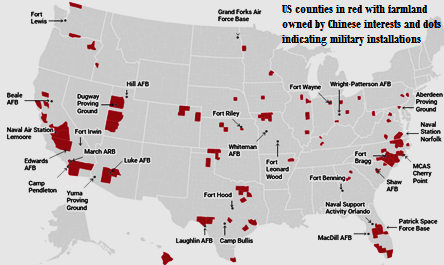
Ahora se está destapando una de las características de esa estrategia. Se trata de la compra de grandes extensiones de terreno cultivable en Estados Unidos y, sobre todo, de la característica de los lugares dónde estas propiedades están situadas, en su mayoría en zonas aledañas a bases y otras instalaciones militares y plantas de energía nuclear del país.
La creciente preocupación por las tierras agrícolas de propiedad china en EEUU deriva de los temores del efecto que pueden ejercer en la seguridad nacional, especialmente en relación con la proximidad a bases militares, a plantas de energía nuclear y a su potencial de espionaje.
En cuanto al volumen de las tierras adquiridas, debe reconocerse que es una fracción del total de tierras extranjeras o agrícolas en el país. Aunque los datos sugieren que la propiedad china es relativamente pequeña, especialmente en comparación con la de otros países, como Canadá, no cabe duda de que su extensión es considerable. Investigadores independientes estimaron que China tenía propiedades en unos 383,935 acres de tierra en EEUU en 2021; de estas alegaciones, el Departamento de Agricultura (USDA) ha confirmado que entidades chinas poseían 277,336 acres [1,125 km²] de tierra agrícola en EEUU el 31 de diciembre de 2023: en Texas (123,708 acres), Carolina del Norte (44,263 acres), Missouri (42,905 acres), Utah (33,035 acres), Florida (12,798 acres) y 20,627 en varios otros Estados, principalmente en California).
- Hits: 1288
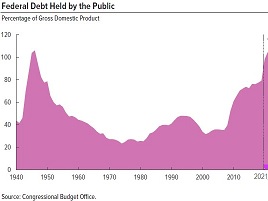

 The other is a Republican initiative in Congress. It is the
 Para la inmensa mayoría de los habitantes de cualquier país, la más importante de sus preocupaciones económicas es cómo sufragar el presupuesto familiar. Este es un problema que muchos experimentan en Estados Unidos. Un caso ilustrativo es cómo, no solo la magnitud del cheque semanal promedio, sino lo que ese cheque realmente puede adquirir, disminuyó cerca del 4% desde que el Presidente Biden tomó el mando hasta que abandonó el puesto. En resumen, el empleado, obrero o trabajador perdió en promedio el 4% de su poder adquisitivo durante esos cuatro años. Pese a que la inflación fue significativamente superior, quedó parcialmente compensada, aunque no totalmente, por los aumentos en los sueldos que, en consecuencia, resultaron ser insuficientes en un 4% en relación con la inflación.
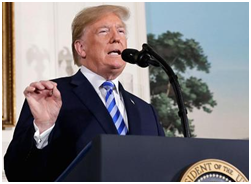 President Trump has dragged his administration into an economic Cold War by imposing high tariffs and sanctions on most countries and blocs of countries that trade with the United States. He announced that all of them had been pursuing trade policies significantly detrimental to the United States' interests for many decades. In particular, exchanging goods and services with China resulted in a growing trade deficit amounting to hundreds of billions of dollars. To a lesser extent, this disparity was also notable in trade with the European Union, India, and many other countries. Therefore, President Trump took the plunge with a sudden and radical policy of achieving parity, which provoked a loud and belligerent reaction among those affected and an avalanche of criticism in the American media and political circles, which predicted an economic collapse caused by overwhelming initial inflation and the subsequent descent into a deep depression.