Democracia Participativa
Participatory Democracy
  • Noticias
    News
    • Headlines
    • Titulares
    • Cuba / Cuban Affairs
    • Venezuela / Venezuelan Affairs
    • Navegando / Browsing
  • Derechos
    H. Rights
    • Derechos Humanos / Human Rights
    • Perspectivas / Perspectives
    • Denuncias / Reports
    • Organizaciones / Campaigns
  • Economía
    Society
    • Toma nota.../Take note...
    • Economic Perspective: Doug Casey
    • Perspectiva económica: Martínez-Solanas
    • Columnistas invitados/Guest columnists
    • Mundo Sindical / A Worker's World
  • Documentos
    Data & Referenda
    • DOCUMENTOS / DOCUMENTS
    • Documentos en Español
      • Instrumentos Internacionales y Declaraciones
      • Documentos sobre Derechos Humanos
      • Cuba: Iniciativas Democráticas
      • Documentos sobre Economía
      • Doctrina Social Cristiana
      • Otros documentos y perspectivas
      • Fundamentos / Basics
    • Documents in English
      • International Instruments & Declarations
      • Human Rights Documents
      • Documents on Economy
      • Other Documents
      • Christian Social Thought
    • Libros / Outstanding Books
    • Nosotros / About us
      Enlaces / Links
  • Elecciones
    Referenda
    • Elecciones / World Elections
    • Referendos / Plebiscites' articles
  • Foro
    Debate
    • Categorías / Forum categories
    • Mensajes / Recent Topics
    • Buscar / Search in Forum
Democracia Participativa
Participatory Democracy
  1. Home
  2. Economía

Columnistas invitados/Guest columnists

The changing paradigm in democratic elections, people’s representation

Written by * Desmond Boi on 21 November 2016. Posted in Columnistas invitados / Guest columnists.

The intent of any election is to put to test the mechanisms by which modern representative democracy is operationalized and made pro-electorates. An election, therefore, is a formal, informed and conscientious decision-making process which the electorates or a population chooses an individual to a hold a public or a corporate office in TRUST on their behalf. This form of representative democracy is practiced through a suffrage, that is, the right to vote and be voted in an elections, the right or chance to make or express an opinion and or participate in a decision-making process on matters that affect one’s life.

Despite the growing public appreciation of the vital role of representative democracy in nation building and economic development, still there exist the challenges of building a sustainable democracy that is purely based on the basic principles and values of good governance.

On balance, though, it is possible to make an association between direct democracy and the representative democracy which may give us what we call “participatory democracy”.
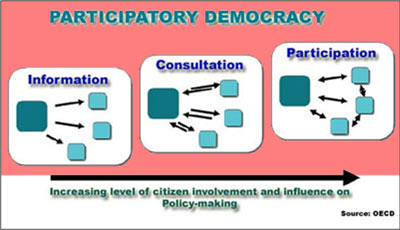
The world over, participatory democracy is being seen as the best bet for tackling and to a significant extent fixing the limits and handicaps of representative democracy. Participatory democracy denotes the form in which the people literary rule themselves, either directly or indirectly through their democratically elected leaders and governance institutions.

Read more …

  • Hits: 8671
Write comment (0 Comments)

The Obama Legacy in Cuba

Written by Elliot Abrams on 20 October 2016. Posted in Columnistas invitados / Guest columnists.

Published by Council on Foreign Relations

Moving fast in his waning months, President Obama concluded he had not done enough to overturn U.S. policy toward Cuba and ensure that his new policies will survive. So he has issued a new “Presidential Policy Directive” that goes even further.

Obama celebrates agreement with Castro in CubaTwo things are striking about it. First, what the United States gets in return from the Castro regime is exactly and precisely nothing. This is not a bargained-for exchange; Castro makes no promises, allows no one to get out of prison, does not even make a vague allusion to reform. Nothing. This is because Cuba policy is, for the President, less an exercise in statesmanship than the true product of ideological politics. This policy is a remedy, a medicine, an apology, to make up for what he sees as decades of American sin toward Cuba.

Of course, in Mr. Obama’s imagination “Cuba” means “Castro;” the Cuban people are really not an actor here. The benefits of all the commerce that will now grow go directly to the regime. For example, the hotels that Mr. Obama wishes to fill with American tourists are owned by the Cuban military. No matter, it seems.

One can see glimpses of all this in the actual text of the Directive. For example, take these lines: “we are not seeking to impose regime change on Cuba; we are, instead, promoting values that we support around the world while respecting that it is up to the Cuban people to make their own choices about their future.”

Read more …

  • Hits: 8722
Write comment (0 Comments)

Corruption and History

Written by Carlos Alberto Montaner on 18 October 2016. Posted in Columnistas invitados / Guest columnists.

Brazilians Lula da Silva and Dilma Rousseff could end up in prison for corruption. Especially Lula. Also the Spaniard Mariano Rajoy and the Argentine Cristina Fernández de Kirchner, if prosecutors prove the charges that hang over their heads.

Why go on? At this moment, there are more than 30 European and Latin American heads or former heads of state in prison, expatriated, or suspected of embezzlement, misappropriation of funds, money laundering and other coarser ways to steal the resources of society for personal benefit or to foment political patronage. I’m not even including the Africans and many Asians, because the list would be too long. Lula da Silva targeted by Brazilian justice

The usual scheme consists of a criminal triangle. There are some politicians or functionaries who have the authority to grant juicy state contracts and there are some businessmen who are willing to undertake those projects but not to win them in open, clean and truly competitive bids but through tricks and deals. Between them there’s usually a “bagman” who negotiates with the businessmen in the name of the politicians, receives the bribe, splits it, and keeps a slice.

Read more …

  • Hits: 7845
Write comment (0 Comments)

Ecuador's shrinking Democracy

Written by Luis Fleischman on 18 October 2016. Posted in Columnistas invitados / Guest columnists.

Rafael CorreaLast August, the Secretary of the Inter-American Commission on Human Rights, Emilio Alvarez Icaza, criticized the state of democracy in Ecuador. Alvarez pointed out that Ecuador’s democracy enjoys electoral democracy but as a whole, democracy is weakened by repression of freedom of expression and freedom of association. Alvarez condemned in strong terms, the fact that cartoonists and other media outlets are outlawed if they criticize the president.

Of course Alvarez’s declarations were only the tip of the iceberg in a country where formal democracy works as a façade better than in any other country in the region. However, Ecuador has been under the radar, hardly detected by the international community. Furthermore, the regional anti-democratic environment that has prevailed in the last two decades has sustained this abysmal state of democracy in Ecuador.

Last December the officially controlled National Assembly approved fifteen constitutional amendments that established that all public offices could be reelected indefinitely. This applies also to the president but only after May, 2017, which effectively excludes Rafael Correa from running in the next presidential elections. However, Correa could run indefinitely after 2021.

Read more …

  • Hits: 8056
Write comment (0 Comments)

Bienvenidos a la era de la “posverdad”

Written by Miquel Urbeneta * on 13 October 2016. Posted in Columnistas invitados / Guest columnists.

Diarios de referencia de diferentes países reflexionan sobre el valor de la verdad a raíz del éxito de campañas políticas basadas –por lo menos, en parte– en mentiras flagrantes. De esta forma, los medios profundizan en su propia crisis más allá de la disrupción tecnológica y de los cambios en los modelos de negocio. Lo que está en juego no es la forma sino el fondo: la misma sustancia de las sociedades democráticas. 

En los últimos meses, el mundo occidental ha asistido a dos hechos políticos de gran impacto: el Brexit y la nominación de Trump como candidato republicano a la Casa Blanca. Por lo que respecta al Brexit, las declaraciones de Nigel Farage en sus primeras reacciones al resultado podrían haber causado un gran escándalo. Sin embargo, el reconocimiento de que, una vez fuera de la Unión Europea, Gran Bretaña no dispondría de los millones de libras prometidos para su sistema sanitario no parece que haya tenido mayores consecuencias. Y si Trump insiste en que Obama es uno de los fundadores del Estado Islámico tampoco parece que genere un revuelo especial. Episodios como estos han suscitado un debate en los medios de comunicación, una discusión que en buena parte trata sobre el papel de los mismos medios. ¿Cómo ha podido suceder?, se preguntan los periodistas. ¿Hasta dónde llega nuestra responsabilidad? ¿Somos culpables?

En esta discusión tiene un lugar importante el artículo en el que la directora de The Guardian, Katharine Viner, rescata el concepto de post-truth politics. Si bien la mentira ha existido siempre y los políticos la han utilizado, Viner señala que la novedad ahora consiste en que ha desaparecido la tensión: se reconoce que se ha mentido como si tal cosa y, además, el público lo acepta sin mayores problemas. El artículo de Viner, “How technology disrupted the truth”, ha tenido un cierto eco y, de hecho, el debate sobre la posverdad ha encontrado un hueco en otros medios de referencia (The Economist, Le Monde, Slate, Washington Post...). Este debate –que ya es relevante que se produzca– pone sobre la mesa la estructura básica de nuestras democracias e invita a considerar los cambios que ha sufrido en los últimos años.

Discurso emocional

Read more …

  • Hits: 11447
Write comment (0 Comments)

More Articles …

  1. Colombian People’s Rejection Of Peace Agreement Provides Opportunity For A Better Deal
  2. ¡The Right to Write Fiction is under attack!
  3. Una peligrosa magia verbal
  4. DEMOCRACIA y LIBERTAD - Ayer, hoy y mañana
  5. Se equivocan los que critican la desigualdad de ingresos
  6. El Capital de las Naciones
  7. Cuba: Las cuentas y los cuentos de las reformas
  8. Nunca más el Ateísmo
  9. El mundo después del Brexit
  10. El devenir de la democracia en América
  11. Mercantilismo Siglo XXI
  12. “El Poder de los Sin Poder” de Vaclav Havel y mi análisis de la realidad cubana
  13. Cuba's influence in American academia
  14. La Legalidad debe tener supremacía sobre la Política en América Latina

Page 75 of 99

  • 70
  • 71
  • 72
  • 73
  • 74
  • 75
  • 76
  • 77
  • 78
  • 79
Bienaventurados los que tienen hambre y sed de justicia, porque ellos serán saciados.
Jesús de Nazaret

Buscar / Search

Identificarse / Login

Identificarse / Login

  • Forgot your password?
  • Forgot your username?

Popular Economía / Most Read

  • ¿Contemplamos un simple Capitalismo de Estado orientado a Estados Unidos o una penetración hegemónica china?
  • Esclavitud y Servidumbre Socialista
  • EEUU: Seguimos fabricando pobreza ... e Inmigrantes con Inteligencia Artificial (IA)
  • La Batalla Para Salvar A Nueva York
  • Two U.S. bills deserve the full support of all Americans for passage by Congress

Documentos Economía / Random Economy Docs

  • Creating Good and not just Goods
  • Human Development Report 2020
  • Towards Reforming the International Financial and Monetary Systems in the context of Global Public Authority
  • El Indicador de Progreso Genuino y el Índice de Desarrollo Humano

Currency Converter

Convert
→

Hacer una donación
/ Donate now

  • Consulta popular en plebiscito

    [

  • Cuba: Libertad y Responsabilidad. Desafíos y Proyectos

    El autor de esta magna obra sobre la realidad cubana es Dagoberto Valdés Hernández, un Ingeniero Agrónomo de profesión, educador de vocación y dirigente católico de alma. Desde su Provincia de Pinar del Río, en Cuba, ha dirigido con firmeza y serenidad la Revista Vitral, con una notable capacidad...

  • Edificando la Democracia Participativa

    Edificando la Democracia Participativa Gerardo E. Martínez-Solanas Una de las razones fundamentales para promover la democracia participativa consiste en que tal sistema ofrece al ciudadano una capacidad de participar en decisiones orientadas a desarrollar una economía socialmente justa y...

  • Audiencia Nacional española desata crisis diplomática con China

    Dictó una orden de busca y captura contra cinco miembros de la nomenclatura china por delitos de lesa humanidad y genocidio contra el pueblo tibetano Exteriores alega que la división de poderes le impide influir en los jueces El expresidente Jiang Zemin y el exprimer ministro Li Peng (ambos en la...

  • Los malos usos de la Historia

    Una guerra dinástica, típica del Antiguo Régimen, no se puede explicar como un conflicto nacional entre España y Cataluña.Tampoco la unión de reinos bajo los Reyes Católicos fue el nacimiento de una nación Puede que alguien que no haya dedicado mucho tiempo a pensar sobre estas cosas crea que la...

Facebook
© 2003 - 2026 Participatory Democracy Cultural Initiative, Inc.
  • Noticias
    News
    • Headlines
    • Titulares
    • Cuba / Cuban Affairs
    • Venezuela / Venezuelan Affairs
    • Navegando / Browsing
  • Derechos
    H. Rights
    • Derechos Humanos / Human Rights
    • Perspectivas / Perspectives
    • Denuncias / Reports
    • Organizaciones / Campaigns
  • Economía
    Society
    • Toma nota.../Take note...
    • Economic Perspective: Doug Casey
    • Perspectiva económica: Martínez-Solanas
    • Columnistas invitados/Guest columnists
    • Mundo Sindical / A Worker's World
  • Documentos
    Data & Referenda
    • DOCUMENTOS / DOCUMENTS
    • Documentos en Español
      • Instrumentos Internacionales y Declaraciones
      • Documentos sobre Derechos Humanos
      • Cuba: Iniciativas Democráticas
      • Documentos sobre Economía
      • Doctrina Social Cristiana
      • Otros documentos y perspectivas
      • Fundamentos / Basics
    • Documents in English
      • International Instruments & Declarations
      • Human Rights Documents
      • Documents on Economy
      • Other Documents
      • Christian Social Thought
    • Libros / Outstanding Books
    • Nosotros / About us
      Enlaces / Links
  • Elecciones
    Referenda
    • Elecciones / World Elections
    • Referendos / Plebiscites' articles
  • Foro
    Debate
    • Categorías / Forum categories
    • Mensajes / Recent Topics
    • Buscar / Search in Forum