Tel Aviv, Aug. 14 (DPnet).– The India-Middle East-Europe Economic Corridor (IMEC), was unveiled at the G20 summit in New Delhi. Envisioned as a network of ports, railways, energy infrastructure, fibre-optic cables, and logistics links connecting India to Europe through the United Arab Emirates, avoiding the Strait of Hormuz, through Israel, and from Haifa to the Port of Piraeus in Greece, it was widely seen as the democratic world’s answer to China’s Belt and Road Initiative and to Iran's aggressive influence over the Strait.
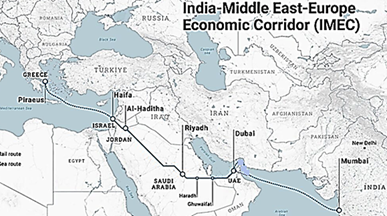
The original vision was elegantly simple. Goods would move from India across the Arabian Peninsula, through the United Arab Emirates, Saudi Arabia and Jordan, into Israel and onwards through Haifa to Europe, bypassing both dangerous maritime bottlenecks and unstable countries including Iran, Iraq, Syria, and Lebanon – and building a wide-ranging tech ecosystem around the corridor.
For Israel, the IMEC has the potential to become its most consequential strategic-economic project in decades, but the deal might be stillborn if Israel can’t engage in smart diplomacy and long-term thinking. “The question right now is whether Israel can be bypassed,” says former Knesset member Doron Avital, the former commander of the elite Sayeret Matkal unit who has become one of the initiative’s leading advocates.
Countries that become indispensable trade junctions attract investment precisely because businesses want to locate where capital, infrastructure, and talent converge. If the IMEC succeeds with Israel at its centre, Haifa could evolve into the eastern Mediterranean’s principal logistics hub, while Israel’s strengths in artificial intelligence, cybersecurity, semiconductors, desalination, and energy technology would become integrated into supply chains stretching from Bangalore to Berlin. The corridor would export not only goods through Israel, but Israeli services, innovation, and capital outwards.
The disruption to maritime trade in the Persian Gulf and the Red Sea have, if anything, also made it more urgently needed by all parties. The logic is indisputable. India is emerging as the world’s principal engine of economic growth. Europe, increasingly wary of its reliance on Russia since it invaded Ukraine in 2022, is trying to diversify critical economic and energy relationships. And governments increasingly view supply chains not merely as instruments of commerce, but as matters of national security.
Moreover, a Saudi-Israeli normalization attached to a corridor of ports, railways, cables, and energy links would become harder to reverse than a ceremonial agreement. Every train, customs arrangement, data connection, and private investment would create constituencies with something concrete to lose from renewed estrangement. So normalization would be upgraded from a fragile political event into a structure of shared interests.
Saudi-Israeli normalization becomes something larger than another Middle Eastern diplomatic achievement. It is one of the missing political links connecting India, Asia’s fastest-growing major economy with Europe’s largest integrated market.