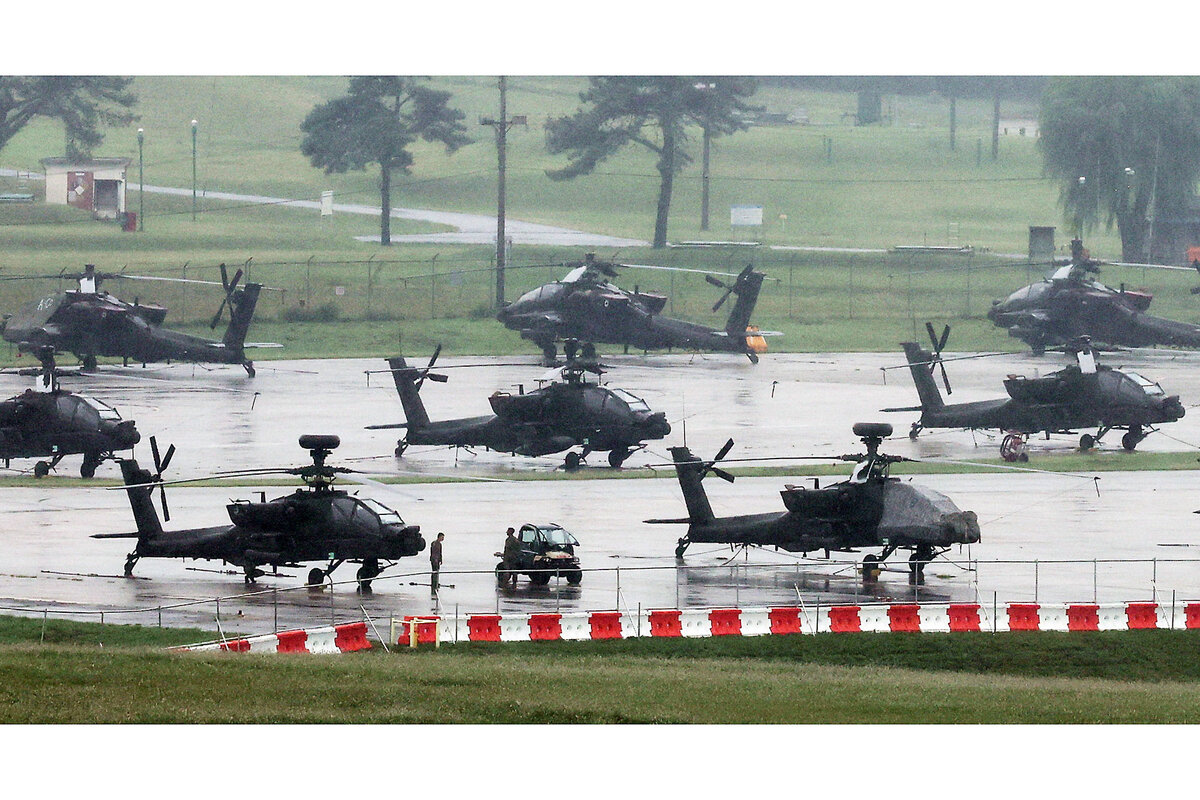
U.S. Army AH-64 Apache attack helicopters parked at Camp Humphrey during annual US-South Korea Ulchi Freedom Shiel joint military exercise on Aug.21, 2026.
Washington DC, Aug. 25.– The South Korean marine corps said Monday that Washington had canceled joint drills originally scheduled for September, citing competing demands in Iran. The announcement comes days after President Donald Trump curtailed another round of high-profile defense exercises, noting that he was disappointed in South Korea’s refusal to help with the U.S. war in the Middle East.
In Seoul, the dual cancellations have added to the sense that U.S. military support has become conditional – and are reigniting calls for South Korea to develop its own nuclear arms.
Several U.S. allies around the world are facing the same challenge: If a country can no longer count on Washington’s support, it must pursue a more self-reliant approach to national security. But South Korea might be best poised to make an actual, radical change toward that end. The government under President Lee Jae-myung is relatively strong, as is South Korea’s economy, and security is top of mind for Korean voters. As the number of military-age men declines and the threat from Pyongyang grows, many are eager to shore up regional stability, but are also wary of getting dragged into other countries’ conflicts.
Acquiring nuclear weapons – a once-taboo notion that now has growing support among South Korea’s public – would dramatically shift the paradigm in northern Asia, and could cement South Korea’s spot in the new world order as a military power unto itself.
(...)
[ Full Text ]