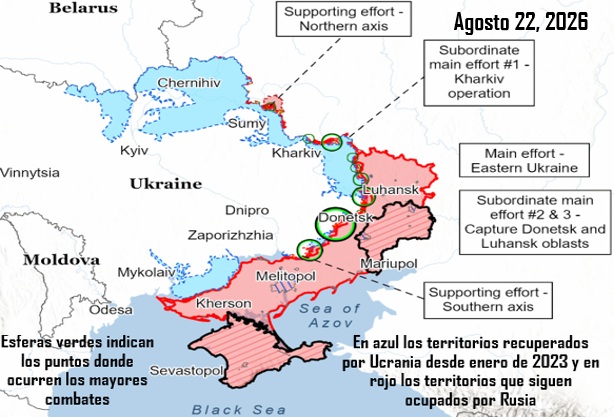
Aug. 23 (DPnet).– In his speech on August 22 at the United Russia Party congress, President Vladimir Putin reaffirmed the party’s identity as the "party of war." He argued that the unavoidable conditions resulting from what he perceives as his party's inevitable victory in the upcoming State Duma elections demonstrate that the Russian people support a prolonged war in Ukraine, leading to total victory. This stance further solidifies the pro-war position as a fundamental aspect of Russia's informal state ideology.
Putin declared that the United Russia Party has a duty to do "everything possible to achieve victory" in Ukraine. He also reiterated that the indiscriminate bombing of Ukrainian cities aims to compensate for Russia’s lack of tactical success on the battlefield, disrupt Ukraine’s domestic defense industry, and exert strong psychological pressure on the population to weaken their resistance.
However, as a matter of fact, Russian forces are currently facing significant setbacks, having lost control of 27.09 square kilometers in August 2026 alone, excluding areas previously infiltrated by Russian troops. This decline in territorial gain is alarming, as Russia's rate of advance has been steadily decreasing since January 2026. Furthermore, the reports from the Ukrainian General Staff are striking: roughly 29,120 Russian casualties were recorded from July 31 to August 22, 2022, resulting in a staggering average of 1,074 casualties for each square kilometer of territory seized.
Moreover, President Putin has candidly acknowledged the detrimental effects of Ukrainian long-range strikes on Russia’s crucial fuel infrastructure. He emphasized the urgent need to bolster the country’s air defense systems. In his August 22 interview, Putin admitted that these Ukrainian strikes not only inflict casualties but also cause significant “economic damage.” This recognition highlights Russia's ongoing struggle to safeguard its vast territory against the increasing effectiveness of Ukrainian attacks.
In the Middle East, the situation seems to have reached a stalemate, with no sign that economic pressure on the regime has shifted the anti-concessions stance of some high-ranking Iranian officials.
At the same time, a group of Iranian officials responsible for managing the economy—often referred to as “realists”—are increasingly warning that escalating economic difficulties could jeopardize the stability of the regime. These officials also appear to support ending the ongoing conflict to alleviate the economic burden on the government.
As a result, the regime's decision-making process may take a significant amount of time to respond, even as the economy continues to deteriorate. Vahidi and other officials who oppose making concessions seem to tolerate domestic unrest more than others. They likely believe that the regime can contain and suppress new protests without changing its current course. They are likely biding their time until the upcoming U.S. elections in November, a pivotal moment that could shift legislative control and potentially lead to a U.S. withdrawal perceived as a significant defeat.


In contrast, key figures like Pezeshkian, Ghalibaf, and Hemmati, who are responsible for steering the economy, are more open than Vahidi and the anti-concession faction to viewing economic decline as a catalyst for policy change. It’s crucial to recognize that these economic managers are, at least publicly, accountable to the electorate, unlike Vahidi and his allies who face no such pressure. This dynamic severely limits the capacity of Pezeshkian, Ghalibaf, and Hemmati to effect meaningful change in Iran’s policy, despite their inclination to adapt.