Money has been losing its intrinsic value during the last 40 years. Nowadays it is just paper with no more value than whatever confidence one might have in the government manipulating it. In the past, money's value was based on the amount of gold reserves but also in its convertibility to silver coins and/or silver bullion.
It all started with the Bretton Woods monetary architecture agreed to in July 1944 during a three-day meeting gathered at that New 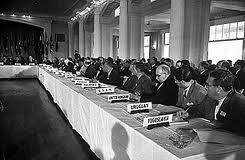 Hampshire's town when the allies were anticipating total victory against Germany and Japan and agreed on the creation of the International Monetary Fund (IMF), and other issues with a main goal of post-WWII reconstruction of devastated European and Japanese industrial bases.
However, the background to these agreements goes back half a century to the point when a US a central bank was created and surreptitiously named Federal Reserve (better known as "The Fed"). The fact is that the previously named Bank of the United States, chartered by Congress in 1791 and the Second Bank of the United States in 1817 were dissolved on 1811 and 1836 respectively. Therefore, from 1836 to 1913, a period of great prosperity and inventions, the US had no central bank. The architects of the creation of the Federal Reserve in 1913 took this well into account to disguise their intentions by adopting such an anodyne name.
Any central bank has three main roles among five others: 1) it employs leverage; 2) it makes loans; and, 3) it creates money. Apart from the five other additional functions, these are the main tasks of The Fed. The last one is the most disturbing. It was precisely this economic architecture developed and strengthened by The Fed in the US, the same that was elaborated in Bretton Woods (with insignificant variants) in the creation of an international organization conceived to manage a world economy.
Again, such a creation of a World central bank was surreptitiously named International Monetary Fund (IMF) to mislead the vast majority of the less informed away from the fact that what it was being built was a global economy, pointing to the ulterior goal of an eventual World government.
- Hits: 8866
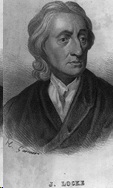 mercantilismo1. Algunos de sus antecedentes los encontramos en la obra de John Locke (1532-1704), quien postula la libertad individual, la estabilidad social, la tolerancia y los fundamentos de los derechos naturales a la vida, la libertad y la propiedad, que acaban conjugándose posteriormente en los instrumentos modernos de derechos humanos. Los encontramos también en la obra de Montesquieu (1689-1755), quien elabora en “
 The Tax Cuts and Jobs Act (TCJA), passed in December 2017, made several significant changes to the individual income tax. These changes include a nearly doubled standard deduction, new limitations on itemized deductions, reduced income tax rates, and reforms to several other provisions. In all, these changes simplify the individual income tax by eliminating the need for millions of households to itemize their deductions.