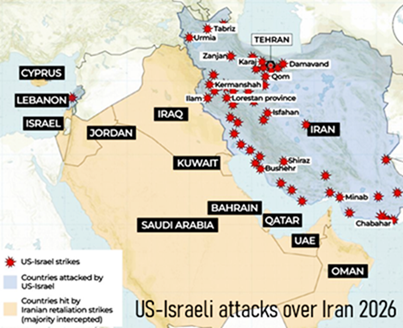
March 2 (DPnet).– The joint US-Israeli forces have decisively struck more than 2,000 key targets throughout Iran, successfully establishing air superiority over Tehran. This coordinated effort has specifically aimed at dismantling Iranian internal security institutions that are crucial for maintaining order and suppressing dissent and the Iranian nuclear and missile capabilities. Notably, their operations have focused on neutralizing security forces operating along Iran's northwestern borders with Turkey and Iraqi Kurdistan, reinforcing a robust stance against regional instability.
The combined force continued to suppress Iranian air defenses to achieve and maintain air superiority over Iranian airspace. The Israeli Air Force (IAF) destroyed one Iranian F-4 and two F-5 fighter jets preparing to take off from the Artesh Air Force 2nd Tactical Airbase in Tabriz, East Azerbaijan Province, on March 1. This airbase houses three Iranian squadrons (the 21st, 22nd, and 23rd Tactical Fighter Squadrons) that fly MiG-29 and F-5 aircraft, according to OSINT social media accounts. Iranian F-4 and F-5 jets retain air-to-air capabilities that could threaten US and Israeli aircraft despite the F-4 and F-5 jets’ age and technological shortcomings compared to fourth- and fifth-generation aircraft.
The combined force also targeted the Shahr-e Rey Law Enforcement Command (LEC) Station in Tehran, which may have contributed to the violent crackdown on protesters during the recent waves of protests in December 2025 and January 2026. Additionally, the combined force has carried out cyberattacks as part of its stated objective to overthrow the regime.
On the other hand, the regime enforced an internet shutdown to hinder Iranians from organizing protests against its authority, especially amid the ongoing U.S. and Israeli strikes. Restoring internet access is crucial not only for empowering the Iranian people but also for advancing the United States' objective of dismantling the oppressive regime..
The inconsistency of Iran’s retaliatory attacks on March 1 suggests that Iranian units may be struggling to coordinate large-scale attacks. Iran appeared to fire significantly fewer munitions at Israel on March 1 than on February 28, which suggests that US-Israeli efforts to degrade Iran’s retaliatory capabilities are succeeding. The combined force conducted several strikes targeting Iranian drone launch facilities in southeastern Iran that Iran likely used to launch drones at its Arab Gulf neighbors. Thousands of these drones has been supplied to Russia in support of its aggression against Ukraine.
The Expediency Discernment Council appointed Ali Reza Arafi as the third member of the Leadership Council. He has long maintained a close relationship with Ali Khamenei, and he likely played a key role in consolidating Khamenei’s religious authority across Iran. He will serve alongside President Masoud Pezeshkian and Judiciary Chief Gholam Hossein Mohseni Ejei. The Leadership Council will assume the supreme leader’s responsibilities until the Assembly of Experts convenes to select a successor.
Meanwhile, Lebanese Hezbollah fired rockets into Israel. This attack would mark the first Hezbollah rocket attack into Israel since the November 2024 Israel-Hezbollah ceasefire agreement. Other members of Iran’s Axis of Resistance, specifically Iranian-backed Iraqi militias, have threatened to retaliate and conducted some attacks targeting Israel and US forces.
Comments powered by CComment