Democracia Participativa
Participatory Democracy
  • Noticias
    News
    • Headlines
    • Titulares
    • Cuba / Cuban Affairs
    • Venezuela / Venezuelan Affairs
    • Navegando / Browsing
  • Derechos
    H. Rights
    • Derechos Humanos / Human Rights
    • Perspectivas / Perspectives
    • Denuncias / Reports
    • Organizaciones / Campaigns
  • Economía
    Society
    • Toma nota.../Take note...
    • Perspectiva económica: Doug Casey
    • Perspectiva económica: Martínez-Solanas
    • Columnistas invitados/Guest columnists
    • Mundo Sindical / A Worker's World
  • Documentos
    Data & Referenda
    • DOCUMENTOS / DOCUMENTS
    • Documentos en Español
      • Instrumentos Internacionales y Declaraciones
      • Documentos sobre Derechos Humanos
      • Cuba: Iniciativas Democráticas
      • Documentos sobre Economía
      • Doctrina Social Cristiana
      • Otros documentos y perspectivas
      • Fundamentos / Basics
    • Documents in English
      • International Instruments & Declarations
      • Human Rights Documents
      • Documents on Economy
      • Other Documents
      • Christian Social Thought
    • Libros / Outstanding Books
    • Nosotros / About us
      Enlaces / Links
  • ELECCIONES
    Referenda
    • Elecciones / World Elections
    • Referendos / Plebiscites' articles
  • Foro
    Debate
    • Categorías / Forum categories
    • Mensajes / Recent Topics
    • Buscar / Search in Forum
Democracia Participativa
Participatory Democracy
  1. Home
  2. Economía
  3. Toma nota.../Take note...

Toma nota.../Take note...

International Humanitarian Assistance and the Struggle of Ideologies: The Cuban Case 

Written by Benigno E. Aguirre ** on 27 December 2023. Posted in Columnistas invitados / Guest columnists.

Benigno E. AguirreThis paper intends to recognize political ideologies as influential determinants of international humanitarian assistance by examining the Cuban case. Ideologies have both internal and external modus operandi. Internally, according to Destutt de Tracy’s original conceptualization, it had five characteristics: it contains an explanatory theory about human experience and the external world; it sets out a program of social and political organization; it recognizes the need for struggle to bring it about; it seeks to recruit loyal adherents, demanding their commitment to the worth of their claims; and it usually confers leadership on intellectuals. While multiple definitions and approaches to the concept of ideology exist, John Thompson’s “external” view of ideology as systems of beliefs, symbols, and language mobilized rhetorically to advance the interest of specific constituencies seems most apt for this case study. For Thompson, the goals of ideologies are to obtain specific social and economic interests and acquire power-overvalued entities: they have to do with the setting of public policy, are supra-individual entities and the property of groups, and are engaged in conflict with other ideologies and systems of social control over the state. Ideologies aim to obtain social and economic interests and control valued ends. Ideologies are used rhetorically to help or justify domination over others in what Thompson calls “systematically asymmetrical power relations.” This process occurs in specific social-historical settings and has five primary ways: 'legitimation,' 'dissimulation,' 'unification,' 'fragmentation,' and 'reification.' Thompson's emphasis on competition for power is a more proper approach when trying to understand struggles among multiple ideologies and the international humanitarian assistance of state actors, as is the case of humanitarian aid to Cuba.

It is newsworthy to note that what follows is neither a history of Cuba and the revolution nor an evaluative, analytical, and critical account of the pros and cons of its economic development programs and practices. Instead, it examines Cuba’s current disaster-related predicaments brought in part by climate change and how the struggle among three main ideologies affects Cuba’s receipt of international disaster aid. Here, the doers of these ideologies are absent, and the ideologies are understood as abstract and idealized conceptual constructions used to try to understand the lack of international disaster aid for Cuba.

Cuba. The present-day setting for international aid to Cuba is minimal and incapable of bringing about effective and long-lasting remedies for the victims of disasters. Cuba is excluded from disaster assistance from US government agencies such as the Department of Agriculture and the U.S. Agency for International Development (USAID). In fiscal year 2020, Cuba did not receive aid from the USAID “LATIN AMERICA AND THE CARIBBEAN USAID/BHA Development and Disaster Risk Reduction Assistance” program. The same is true of USAID’s Climate Change Subcommittee members; none are from Cuba despite the presence of excellent Cuban scientists working in this area. While the agency has supplied limited assistance to needy families and encourages people to organize, its involvement in Cuba is minor: USAID’s 2015 budget for programs in Cuba was $6.25 million. Cuba is also discriminated against by other international agencies, like the Interamerican Development Bank (IDB), and it is excluded from the list of countries that are members of the IDB. It is also infrequently mentioned in available reports of the World Bank, which gives countries in the developing world financial resources for disaster reconstruction and development.

This dire situation is aggravated enormously by the significant increases in the risks of hurricane exposure in Cuba and all other countries in the Caribbean basin due to climate change.

Read more …

  • Hits: 971
Write comment (0 Comments)

The Politics of Freedom

Written by Larry P. Arnn on 23 December 2023. Posted in Columnistas invitados / Guest columnists.

The following text is a segment of the adaptation of a speech delivered on the Regent Seven Seas Mariner on June 30, 2023, during a Hillsdale College educational cruise from Istanbul to Athens by the author, President of Hillsdale College, and originally published in the College's newsletter "Imprimis". The full text published in "Imprimis" can be read HERE

Centralization

America’s Founders set out to build a government entirely upon the will of the great body of the people. This had never been done before. And they set out to accomplish this across a great continent —George Washington’s army was strikingly called the Continental Army— despite the prevailing idea at the time that popular governments could only work in small areas. They succeeded in doing both these things, and the way they succeeded is contained in the American Constitution, the longest-living and the greatest constitution ever written.

Article I, Section 8 of the Constitution contains 18 paragraphs that enumerate the powers of Congress. Seven of these have to do with national defense, and one with piracy. The rest, save one, mostly have to do with commerce—weights and measures, currency, unimpeded trade between the states, post offices, and post roads. The last power has to do with the federal government’s authority over the District of Columbia. Other powers were reserved for the states and localities.

Centralization of PoawerIn Federalist 63, James Madison writes proudly of the fact that ours will be the first purely representative government. This doesn’t just mean that instead of a king being sovereign, as in England, we would elect our rulers. It means that no one inside the government—none of the people carrying on the activities of the government—would be sovereign. The sovereign would be located outside the government. As Abraham Lincoln would later put it, the constitutional majority is the only true sovereign of a free people. All powers are to be delegated from the society to the government.

A diagram of this system would consist of a large circle representing American society. Inside that large circle, government at all levels would be represented by a much smaller circle, about one-tenth the size in terms of gross domestic product. This smaller circle would be divided then into parts. It would be divided vertically with the federal government on one side and states on the other—that’s federalism—and the federal side would be divided horizontally into the legislative, executive, and judicial powers. It was a brilliant and novel system for gathering authority to a national center for limited national purposes and distributing all other authority outwards. And it worked for a very long time.

Read more …

  • Hits: 1240
Write comment (0 Comments)

El Grave Riesgo de la Dolarización 

Written by Pedro Gómez Martín-Romo on 13 December 2023. Posted in Columnistas invitados / Guest columnists.

2 de diciembre de 2023 8:56h. 

Asunto: El Plan América & El Mito de la Dolarización

Señores, 

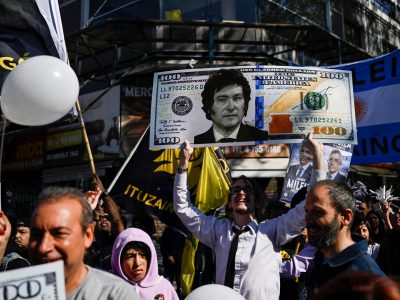
El dinero es, en su más pura esencia, intercambio de trabajo. Por eso la política monetaria debería ser neutral. La emisión de dinero no debería conocer de ideologías. Milei y la dolarización en Argentina
 
Acaba de salir al mercado el libro El Plan América. Este libro explica los pasos que debe seguir Argentina para salir del agujero monetario en el que se encuentra. El Plan América es la única vía que, sin aplicar con rigor el Consenso de Washington, permite reactivar la economía, recobrar la soberanía monetaria, atraer inversiones no especulativas, controlar la dominancia fiscal y la dominancia monetaria, estabilizar el valor de cambio y evitar la inflación, etc. Este libro cambiará la historia de Argentina por basarse en el Patrón Interés, un novedoso sistema de emisión de dinero que dota valor a la moneda basándose en los activos nacionales, con un ancla o límite de emisión monetaria más robusto que el propio oro. 
 
Uno de los capítulos del libro está dedicado a analizar el mito de la dolarización. Resumimos brevemente las reflexiones que el libro ofrece sobre esta tramposa herramienta monetaria. 
 
Errores técnicos flagrantes de la dolarización

Read more …

  • Hits: 1007
Write comment (0 Comments)

Un análisis racional y una advertencia sobre la guerra en Ucrania

Written by Gerardo E. Martínez-Solanas on 01 December 2023. Posted in Columnistas invitados / Guest columnists.

Gerardo E. Martinez-SolanasResulta totalmente incomprensible para cualquier análisis racional que se esté divulgando la idea de que los países democráticos que apoyan a Ucrania en la defensa de su territorio invadido, puedan abandonarla o, en el mejor de los casos, reducir considerablemente los suministros para el esfuerzo bélico de su defensa.

Estos rumores sólo sirven para alentar al invasor a persistir en su esfuerzo agresivo, prolongando la guerra precisamente en momentos en que se nota el agotamiento de su capacidad militar, el fracaso total de sus ofensivas y la gradual pérdida de los territorios que había ocupado. Sencillamente, la realidad es que Ucrania ha estado ganando la guerra desde principios de este año y sólo se requiere que se le preste la asistencia militar necesaria hasta agotar no sólo a las fuerzas enemigas sino el vapuleado prestigio del dictador Putin, responsable de llevar a su país a una costosa guerra que , además, le está costando centenares de miles de vidas de los mejores soldados de sus fuerzas armadas, sin contar buques de guerra hundidos, decenas de miles de misiles utilizados con muy pobres resultados estratégicos y más de un millar de tanques de guerra destruidos.

Es un hecho que Rusia está perdiendo la guerra y su capacidad para sostenerla se está agotando rápidamente. Incluso puede verse obligada a retirarse de Crimea ante la ofensiva ucraniana prevista en la primavera de 2024. En realidad, Crimea no es tan importante como un peón de la geopolítica rusa sino que es para Putin y para muchos ultranacionalistas rusos una cuestión de prestigio y orgullo nacional. Crimea es el símbolo de los grandes confines del imperio que Putin está tratando de reconstruir a sangre y fuego. Pero Crimea ya no es esencial para el dominio del Mar Negro, y controlar el Mar Negro significa muy poco cuando los rusos no pueden controlar el Bósforo. 

Read more …

  • Hits: 1023
Write comment (0 Comments)

Oportunidad Histórica para profundizar la DEMOCRACIA

Written by Gerardo E. Martínez-Solanas on 10 November 2023. Posted in Columnistas invitados / Guest columnists.

En la lucha por el poder, desencarnada, sin fundamento ideológico, político y de valores, se utilizan más los “slogans”, las “frases hechas”, las “consignas” y menos el poder avanzar en la solución de los problemas, carencias y necesidades de la comunidad y del pueblo.


por José Merced González Guerra
Fundador del CENPROS
Publicado originalmente por CENPROS
en su revisa Trabajo y Democracia Hoy

La actual coyuntura sociopolítica que estamos viviendo, nos obliga a profundizar la realidad política en la que se desarrolla el proceso de democratización en México. Con mucha anticipación se ha iniciado el proceso, en función de las elecciones generales de julio del 2024, hay términos legales establecidos en nuestra Constitución que deberían de marcar la pauta para orientar, informar, desarrollar todo el proceso electoral a todos los niveles y hay instituciones encargadas de coordinar, supervisar y responder a los objetivos del mismo proceso electoral, que en este caso, se refieren a la renovación de la Presidencia de la república y a los diputados y senadores del Congreso Nacional, algunos gobernadores de los estados, presidencias municipales y otros cargos inherentes a los mismos.

Como vemos, el escenario es meramente electoral y la modificación se da a nivel de autoridades responsables de este proceso, partidos políticos, organizaciones e instituciones de la sociedad civil y otras de diferentes actores y sectores interesados en los resultados del mismo.

Las candidaturas a los cargos de elección popular se multiplican a todos los niveles y en todos los sectores, la mayoría de ellos sin vocación, sin información, buscando el patrocinio y padrinazgo político que los impulse a lograr un cargo, una función, una misión, que les permita tener el ansiado "poder“.  Democracia

Y esto es lo fundamental para nosotros, cuando emprendimos este proyecto de promoción social y este instrumento de información y formación denominado Trabajo y Democracia Hoy, es lo que nos impulsa a profundizar, a promover el análisis crítico y autocrítico de lo que es y la misión de la democracia en un país como el nuestro. Esta palabra que se ha ido desnaturalizando en el término político y que prácticamente la utilizamos en términos electorales para tratar de “elegir” a un candidato o candidata que responda a nuestros intereses en función de objetivos, que muchas veces no son los que necesita y requiere la comunidad y el pueblo.

Read more …

  • Hits: 1006
Write comment (0 Comments)

More Articles …

  1. The new global war with two active fronts: Ukraine and Gaza
  2. La Política, ¿es "Algo Sucio"?
  3. El Terrorismo y las Alineaciones
  4. Maniqueísmo en la política de Estados Unidos
  5. Crisis en Gaza: Guerra y oportunidad de paz
  6. Offshore Wind is an Economic & Environmental catastrophe
  7. La liberación del pensamiento literario
  8. Socialism’s Fabian strategy
  9. America and the Future of Globalization
  10. Tocqueville and Catholicism in America
  11. La libertad académica seriamente amenazada
  12. La China del emperador Xi Jinping
  13. The Cuba-China Espionage Nexus: New or Old?
  14. La crisis del Grupo Wagner y su impacto en América Latina

Subcategories

Perspectiva económica: Martínez-Solanas Article Count:  122

Perspectiva Económica: Elías Amor Article Count:  35

Perspectiva económica: Castañeda Article Count:  89

Columnistas invitados / Guest columnists Article Count:  1310

Mundo Sindical / A Worker's World Article Count:  227

Perspectiva Económica: Doug Casey Article Count:  6

Page 139 of 224

  • 134
  • 135
  • 136
  • 137
  • 138
  • 139
  • 140
  • 141
  • 142
  • 143
Hay muchos más casos de limitaciones a la libertad ciudadana por intrusiones graduales, silentes, de gobernantes que por usurpaciones súbitas y violentas.
James Madison (1788)

Buscar / Search

Identificarse / Login

Identificarse / Login

  • Forgot your password?
  • Forgot your username?

Popular Economía / Most Read

  • Un Cero a la Izquierda
  • Retirarle fondos al Consejo de Derechos Humanos es un error monumental
  • ¿Premio Pulitzer a la desinformación?
  • ¿Qué es DOGE? ¿Cómo funciona? ¿Quién lo dirige?
  • Money, money, money – The US' new political approach

Documentos Economía / Random Economy Docs

  • El Indicador de Progreso Genuino y el Índice de Desarrollo Humano
  • Human Development Report 2020
  • Towards Reforming the International Financial and Monetary Systems in the context of Global Public Authority
  • Creating Good and not just Goods

Hacer una donación
/ Donate now

  • Consulta popular en plebiscito

    [

  • Cuba: Libertad y Responsabilidad. Desafíos y Proyectos

    El autor de esta magna obra sobre la realidad cubana es Dagoberto Valdés Hernández, un Ingeniero Agrónomo de profesión, educador de vocación y dirigente católico de alma. Desde su Provincia de Pinar del Río, en Cuba, ha dirigido con firmeza y serenidad la Revista Vitral, con una notable capacidad...

  • Edificando la Democracia Participativa

    Edificando la Democracia Participativa Gerardo E. Martínez-Solanas Una de las razones fundamentales para promover la democracia participativa consiste en que tal sistema ofrece al ciudadano una capacidad de participar en decisiones orientadas a desarrollar una economía socialmente justa y...

  • Audiencia Nacional española desata crisis diplomática con China

    Dictó una orden de busca y captura contra cinco miembros de la nomenclatura china por delitos de lesa humanidad y genocidio contra el pueblo tibetano Exteriores alega que la división de poderes le impide influir en los jueces El expresidente Jiang Zemin y el exprimer ministro Li Peng (ambos en la...

  • Los malos usos de la Historia

    Una guerra dinástica, típica del Antiguo Régimen, no se puede explicar como un conflicto nacional entre España y Cataluña.Tampoco la unión de reinos bajo los Reyes Católicos fue el nacimiento de una nación Puede que alguien que no haya dedicado mucho tiempo a pensar sobre estas cosas crea que la...

Facebook
© 2003 - 2025 Participatory Democracy Cultural Initiative, Inc.
  • Noticias
    News
    • Headlines
    • Titulares
    • Cuba / Cuban Affairs
    • Venezuela / Venezuelan Affairs
    • Navegando / Browsing
  • Derechos
    H. Rights
    • Derechos Humanos / Human Rights
    • Perspectivas / Perspectives
    • Denuncias / Reports
    • Organizaciones / Campaigns
  • Economía
    Society
    • Toma nota.../Take note...
    • Perspectiva económica: Doug Casey
    • Perspectiva económica: Martínez-Solanas
    • Columnistas invitados/Guest columnists
    • Mundo Sindical / A Worker's World
  • Documentos
    Data & Referenda
    • DOCUMENTOS / DOCUMENTS
    • Documentos en Español
      • Instrumentos Internacionales y Declaraciones
      • Documentos sobre Derechos Humanos
      • Cuba: Iniciativas Democráticas
      • Documentos sobre Economía
      • Doctrina Social Cristiana
      • Otros documentos y perspectivas
      • Fundamentos / Basics
    • Documents in English
      • International Instruments & Declarations
      • Human Rights Documents
      • Documents on Economy
      • Other Documents
      • Christian Social Thought
    • Libros / Outstanding Books
    • Nosotros / About us
      Enlaces / Links
  • ELECCIONES
    Referenda
    • Elecciones / World Elections
    • Referendos / Plebiscites' articles
  • Foro
    Debate
    • Categorías / Forum categories
    • Mensajes / Recent Topics
    • Buscar / Search in Forum