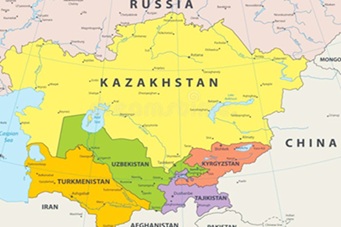
Five Central Asian nations —Kazakhstan, Kyrgyzstan, Tajikistan, Turkmenistan and Uzbekistan— restrict what people can teach children. 
Uzbekistan
Population: 37 million, 2% Christian
Kazakhstan
Population: 20.7 million, 15% Christian
Tajikistan
Population: 10.7 million, ˂1% Christian
Turkmenistan
Population: 7.5 million, 4% Christian
Kyrgyzstan
Population: 7.2 million, 4% Christian
Towering mountain ranges such as the Pamir, Hindu Kush and Tian Shan declare God’s glory across Central Asia. But today, governments throughout the region use restrictive religion laws in an attempt to prevent pastors, teachers and even Christian parents from teaching children about Christ.
 Pastor Parviz knew the risk he was taking as he packed the Christian children’s books into his suitcase and prepared to return home to Tajikistan. But as a pastor and a parent, he also knew that no investment or sacrifice was too great to provide discipleship materials for the children in his small fellowship.
The laws of Tajikistan and other nations in the region restrict and even forbid teaching religious beliefs and practices to children. If the Christian children’s books buried in Parviz’s suitcase were discovered, he could be fined, arrested or even imprisoned. Still, he believed the risk was well worth the gain of discipling children in the Lord.
As he crossed the Tajik border, Parviz was stopped and searched, which led to the discovery and confiscation of the Christian children’s books. He received a significant fine and may face additional punishment.
Five Central Asian nations — Kazakhstan, Kyrgyzstan, Tajikistan, Turkmenistan and Uzbekistan — restrict what people can teach children. Front-line workers report that two of those nations, Kazakhstan and Kyrgyzstan, don’t prohibit instruction that occurs inside officially recognized church facilities but do monitor the churches’ activities. Tajikistan and Turkmenistan have strict laws forbidding the teaching of religion to anyone under 18 unless the teacher is a government-sanctioned and licensed official.
Uzbekistan, a country which had until recently seen some restrictions loosened on Christian worship and practice, passed a new law on Feb. 21, 2025. Parents who teach or allow their children to receive any illegal (non-government-approved) religious education before the age of 18 can be fined more than a month’s wages and sent to jail for 15 days. Front-line workers said the Uzbek government also requires that every book in the country be reviewed and stamped to indicate government approval. “If people are caught with books without the approval code,” a front-line worker said, “it can be a problem for them.” The secret police can harshly punish anyone they consider to be an offender.
Creative Teaching Solutions
A front-line worker in Tajikistan said Christians there have to find ways around the law in order to disciple their children in the Christian faith. Because of the lack of Christian-education materials for children, they must try to access materials digitally. And since print copies can be a liability, they often teach the lessons and show illustrations only on computer screens.
When parents are in church services, their children must be somewhere else. “This restriction is a hard one, especially on parents,” said a Tajik pastor named Olim. “Their kids cannot go to church on Sundays, but they are taught Islam on the streets. It's really hard to go against the flow without a church family supporting and encouraging children.”
One Tajik pastor recently reported that he and another church leader were interrogated by secret police after a girl from their house church shared the gospel with her classmates ...
[ Full text ]
Comments powered by CComment