|
Key Data Points Capital: Lhasa |
Why Tibet?
Tibet is prominently situated at the intersection of three nuclear-armed states: China, India, and Pakistan. This geographic location places Tibet at the crossroads of security dynamics among major powers, with ramifications for international peace and stability, including the strategic roles of the United States, Europe, and other countries in the region. Developments in Tibet, whether related to military infrastructure, energy and resource extraction, border management, or political stability, have direct implications for the security strategies of countries in the region, the United States, and relevant stakeholders in the global community. This unique positioning makes Tibet central to the broader advancement of international security.
China’s ongoing militarization of Tibet poses a direct threat to regional security. In March 2013, President Xi Jinping declared that “To govern the country well, we must first govern the frontiers well; and to govern the frontiers well, we must first ensure stability in Tibet.” Subsequently, the Tibet Military District was elevated to a sub-theater command under the Western Theater Command in 2016, marking a pivotal change in terms of operational autonomy and integration into the People Liberation Army’s (PLA) modernized command structure and reflecting Tibet’s critical role in China’s security framework and strategic priorities. The Tibet Military District’s elevation to a sub-theater command has already had effects, as evidenced by the Droklam (Donglang) standoff (2017), Galwan Valley clash (2020), and infrastructure expansion in Tibet to support military operations in high-altitude areas. In addition to an elevated military presence, there has been a rapid 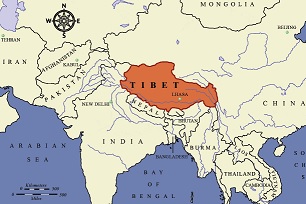 increase in Chinese settlers in strategic frontier rural areas of Tibet. China proactively built over 600 “well-off border villages” (bianjing xiaokang cun) as part of the “Plan for the Construction of Well-off Villages in the Border Areas of the Tibet Autonomous Region” (2017–2020). Additionally, starting in 2017, China has issued 89 standardized place names in the Indian state of Arunachal Pradesh, asserting authority over an area that has never been administered by China.
While Tibet is landlocked, its high-altitude military infrastructure, including airbases, missile sites, and radar systems, serves as a strategic asset for China, enhancing its ability to monitor and influence key maritime regions such as the Arabian Sea, Bay of Bengal, and Indian Ocean.
The Indian Ocean is vital for global trade, handling over one-third of bulk cargo and two-thirds of oil shipments, with tens of thousands of vessels carrying billions of tons annually. Approximately 40% of global oil transit passes through chokepoints like the Malacca and Hormuz Straits, critical for China’s energy security. Through a military buildup in Tibet, coupled with Belt and Road Initiative (BRI) connectivity such as the China-Pakistan Economic Corridor to Gwadar Port, China leverages Tibet to project power and safeguard its trade and energy interests in the Indian Ocean.
Additionally, China’s railway network in Tibet, particularly the Gormo-Lhasa line completed in 2006, has long raised concerns about nuclear militarization of the Tibetan Plateau. While China promotes railway infrastructure as an economic driver for Tibetans, renewed activity at Lop Nur test site in East Turkestan (“Xinjiang Uyghur Autonomous Region”), near Gormo in Tibet’s Amdo region, revives fears of strategic militarization and casts doubt on the veracity of China’s development narrative. Non-proliferation experts have raised deep concern that extensive construction at this historic Chinese nuclear test site indicates preparations for full-scale underground nuclear tests.
Tibet, known as the “Roof of the World” and the “Third Pole,” holds a commanding position at an average elevation of over 4,000 meters, and its abundant water and mineral resources are essential to Asia’s economic prosperity and stability. As Asia’s “Water Tower,” Tibet is the source of the region’s major rivers, including the Indus, Brahmaputra, Sutlej, Salween, Mekong, Yellow, and Yangtze. These waters sustain 1.8 billion people in South and Southeast Asia, making them central to the region’s environmental health and economic security. For this reason, China’s massive hydropower construction scheme threatens regional water security; exacerbates the risk of floods, mudslides, and earthquakes; and stands to drive the displacement of hundreds of thousands of Tibetans. It also enhances Beijing’s strategic control over downstream countries. Thus, China’s plans amplify geopolitical tensions, particularly with India, and necessitate an urgent international call to cease all hydropower dam construction to mitigate environmental and regional instability.
Tibet’s vast reserves of critical minerals present an additional economic and trade dynamic. The recent discovery of rare earth minerals along a 1,000-km (621 miles) belt in the “Tibet Autonomous Region” (TAR) has estimated reserves potentially surpassing Bayan Obo mine in Inner Mongolia, which accounts for 40% of global rare earth reserves. This stands to reinforce China’s dominance in the critical minerals supply chain ...
[ Full text ]
Comments powered by CComment