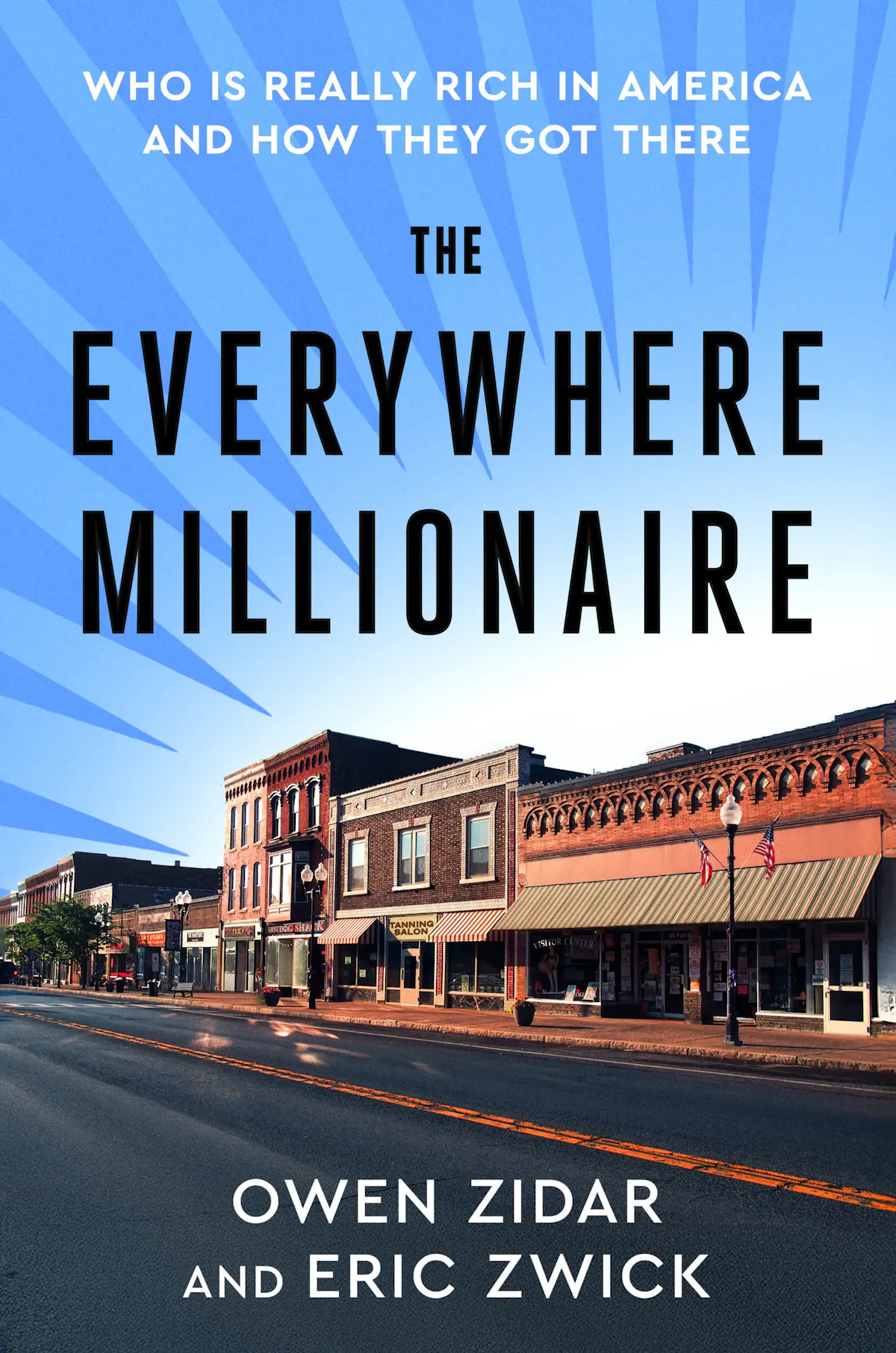
From two leading economists comes a groundbreaking new portrait of the hidden fortunes of Main Street business owners―ordinary Americans who built extraordinary wealth and are quietly rewriting the rules of money and power.
Publisher : Henry Holt and Co.
Publication date : September 15, 2026
Language : English
Print length : 368 pages
ISBN-13 : 978-1250378507
Americans have a lot of misconceptions about the rich. This becomes clear when you read The Everywhere Millionaire by Owen Zidar and Eric Zwick. The authors open with the deceptively simple question: “Who are the rich in America?” They go on to show that wealth in this country “is more abundant, and closer to home, than most people think.” In nearly every city and town, owners of apparently ordinary businesses have accumulated extraordinary fortunes.
“The rich” here are defined as households with at least $5 million in wealth, placing them in roughly the top 4% as of 2022. Nearly five million American households clear that threshold. More narrowly, they define “Main Street Millionaires” as rich owners of private businesses. They estimate there are about three million of them, and their average wealth is around $25 million. Collectively, Main Street Millionaires possess more than thirteen times the wealth of the Forbes 400.
The Everywhere Millionaire may sound confusingly familiar to readers of Thomas J. Stanley and William D. Danko’s 1996 book, The Millionaire Next Door: The Surprising Secrets of America’s Wealthy, which became famous for showing that many millionaires were surprisingly ordinary-looking, frugal Americans who had quietly accumulated wealth over time. But despite the similarity in the titles, Zidar and Zwick’s book is not a sequel, and its subjects are considerably wealthier. They are not interested in people simply because they have crossed the $1 million mark. Their broader definition of “the rich” begins at $5 million in household wealth, while much of the book focuses on wealthy private-business owners worth far more. In that sense, the “Everywhere Millionaire” is not quite the old “Millionaire Next Door.”
The subjects of the book often refrain from answering surveys. Their pass-through businesses are even harder to see, although pass-throughs now account for 95% of American businesses, employing half of all workers and generating the majority of business income. The records connecting those businesses to their owners and workers had been scattered across separate IRS databases. Zidar and Zwick’s contribution came after they spent years linking records across those databases. This has enabled them to “make the rich visible and correct misconceptions about who they really are.”
They Are the 1%
The three million Main Street Millionaires described in the book live all over the country, not just on the coasts. Being a doctor or a lawyer is not enough to put you in the top 1%. The richest Americans often run “boring” businesses: HVAC companies, car dealerships, restaurants, companies ripping up floors in high schools, and so on. The tech titans may capture the imagination, but people can make a lot of money from chains of dry cleaners, dental practices, strip malls, food distribution, convenience stores, homebuilding, and manufacturing products that most consumers hardly think about, such as toilet paper, trash bags, and restaurant liners.
They work hard. Zidar and Zwick depict people with their noses relentlessly to the grindstone, working evenings and weekends and having few hobbies outside of work. They are on the older side; the median age of decamillionaire business owners is sixty-two, and fewer than 10% are under forty—simply because building a business and accumulating wealth takes time. “Boring” businesses don’t require spectacular creativity, but it is necessary to grow them methodically over time, gradually opening new locations and expanding.
Steven Tabak’s family business, Jersey Paper, dates to the 1930s. Over several generations, the family grew it into one of the largest paper-supply companies in New Jersey, distributing paper products, packaging, plastics, and other supplies across New Jersey, metropolitan New York, and eastern Pennsylvania. Love’s Travel Stops & Country Stores grew from a single roadside operation into 640 locations in forty-two states. By the time Tom Love died in 2023, the private company was valued at around $26 billion, with family wealth around $13 billion.
Dot Foods, an apparently unglamorous food redistribution company, grew to nearly 7,000 employees and approximately $10.6 billion in annual revenue. Leprino Foods now makes more cheese than anyone else in the world. The same pattern of relentless, methodical expansion can be seen in family-controlled grocery businesses such as Meijer, Wegmans, and Brookshire Brothers. They methodically grow their ordinary businesses, adding locations, increasing scale, and doing the same thing better and bigger over time, creating extraordinary wealth. The most memorable illustration of this point has nothing to do with Silicon Valley, finance, or professional sports. The authors put annual US dental-services revenue at roughly $165 billion, more than the combined revenue of Formula One, the NFL, NBA, Major League Baseball, NCAA sports, and the PGA. There really is an extraordinary amount of money in industries that most people hardly think about, because we take them entirely for granted.
Joining the Club
It’s not necessary to inherit wealth or a business to join the ranks of the richest 1%. Zidar and Zwick estimate that only about 20% of their subjects inherited their businesses; the richest are mostly self-made. Inheritance also does not guarantee that a family will stay at the top. As ownership passes from one generation to the next, it branches out “like a family tree,” with the original wealth itself becoming divided and fragmented among more heirs, often making governance and decision-making more difficult. The heirs themselves also tend to be less hardworking and frugal than the relentless founders. Even in what the authors call America’s “family-firm economy,” inherited wealth can disappear surprisingly quickly.
The best way to get rich is simply by doing very ordinary things extraordinarily well.
If you desire to start a business yourself and want to try to join the ranks of the richest 1%, it is useful to know that early labor-market experience is crucial (this is something worth mentioning to your kids before sending them off to college). Working inside an industry allows people to acquire practical, industry-specific knowledge that may give them insights into how to improve the practice when starting a business of their own. Before somebody can disrupt an industry, it may help to work in it.
Dick Portillo is a classic example. He grew up poor, living for a time in Chicago’s Cabrini housing project. In 1963, he opened a hot dog stand in Villa Park, Illinois, even though he had never cooked a hot dog in his life. From that one stand, he built the Portillo’s restaurant empire without franchises or outside investors, and eventually sold the business for nearly $1 billion.
Successful entrepreneurs tend to be relentless tinkerers and improvers. Portillo refused to give his managers desks or offices, forcing them to stay out in the restaurant, close to employees, customers, and the daily operation. As a result, Portillo’s restaurants were making three times the average revenue of a McDonald’s restaurant. Several businesses in the book switched to selling frozen pizzas and quiches, realizing they could cut costs if the stores did not use expensive large ovens. Arch Aplin built Buc-ee’s by constantly “tinkering with the design,” locating stores in growing communities, keeping the toilets gleaming, and turning a gas-station stop into entertainment.
Soaking the Rich
Up through the final section of the book, a reader might have the impression that Zidar and Zwick are pro-business. Their stories are full of admiration for hard work, risk-taking, ingenuity, and relentless tinkering. But in the book’s final section, the richest 1% come in for some heavy criticism for using that same ingenuity to diminish their tax burden, and for using their political influence to keep their privileges.
Business owners are heavily overrepresented in elected offices. Even though they make up only about 3% of the US population, these wealthy business owners are ten times as likely to sit in a state legislature as factory workers are.
In reality, some of the tax strategies described in the book seem perfectly reasonable. For example, aging founders may minimize taxes by transferring ownership of their businesses over the course of a decade instead of transferring all at once and causing a large tax event in the process. As the adage goes: tax avoidance is legal; tax evasion is not. Zidar and Zwick know the distinction, of course, but at times they sound surprised that, given two perfectly legal ways to organize a company, a business owner chooses the one with the lower tax bill.
The tax code contains incentives: the government gives entrepreneurs and investors tax advantages because it wants them to start businesses, create jobs, invest, innovate, and engage in other socially useful economic activity. Doing what the tax code was designed to encourage is not necessarily an abuse of the system, even if it means paying less in taxes.
Zidar and Zwick argue for higher effective taxation of wealthy business owners, but they never engage with the work of Arthur Laffer, who showed that higher tax rates do not mechanically translate into proportionally higher tax receipts because taxpayers change their behavior if tax rates spike. They will work, invest, organize businesses, and arrange their finances differently, so total tax receipts may not rise proportionally and, in some cases, may not increase at all.
The final chapters become boringly partisan. Republican tax cuts, from Reagan through Trump, receive continuous criticism, while approval is showered on Joe Biden and other Democrats for their efforts to close what the authors call “loopholes.” It is grossly unfair to suggest that the staggering $40 trillion government debt fiasco is caused by one party alone, or that it could be solved by taxing the richest 1% alone.
In heaping blame on the richest 1%, Zidar and Zwick largely overlook the other side of the fiscal equation: government spending. Milton Friedman warned us that the US “government will spend whatever the tax system raises plus as much more as it can get away with.” On another occasion, he wrote that “Congress will spend whatever the tax system will raise, plus a little more.”
The “little more” currently stands at $2 trillion per year, with $40 trillion in total debt, and there is no prospect of it going down without any serious and very unpopular cuts and reforms. At the start of Donald Trump’s second term, there was talk about DOGE and efforts to cut “waste, fraud and abuse,” but whatever spending they cut was a drop in the bucket, and both the deficit and the total debt continue to rise rapidly. If these trends persist, simple arithmetic would bring US debt to an unprecedented and unsustainable $50 trillion by 2031 and $60 trillion by 2036.
Regardless of whether Republicans or Democrats are in charge, the federal government keeps spending “a little more” than it raises year after year. It is fair to conclude that both parties lack fiscal discipline. Therefore, a serious discussion of the nation’s $40 trillion debt must look beyond the richest 1% and beyond the party divide. Chronic borrowing for present consumption is not merely fiscally reckless; it is a moral failure. Congress cannot keep promising benefits today while passing the bill to future taxpayers. Congress has to address the persistent and unsustainable level of federal spending, especially when the country is neither in a recession nor facing an emergency.
The Everywhere Millionaire has been widely praised in reviews for a book that supposedly contains sensational discoveries. The book is interesting, but examining its primary findings and conclusions, there is hardly anything sensational about them. Most are commonsensical. Should it be a revelation that there are rich people in America beyond the super-rich on the Forbes 400 list? That many Americans get rich by starting a business and growing it methodically over several decades?
Zidar and Zwick correctly note that founders of successful businesses tend to be hardworking and frugal, and these qualities help make them rich. They know, too, that rich Americans are not paying as much in taxes as some people think they should.
Which of these things did we not know already? Nothing here is particularly revolutionary, though it’s worthwhile to read the tiny details and stories of ordinary Americans building their businesses. Perhaps the greatest service these authors have done, however, is to use an extraordinary amount of data to demonstrate once again that bourgeois norms such as work ethic, stability, frugality, and ingenuity can make you quite rich in America. Perhaps in the end, the most interesting thing about the richest 1% turns out to be their normalcy. The best way to get rich is simply by doing very ordinary things extraordinarily well.
- The reviewer, Vladimir Snurenco, is a research fellow at the Center for Social Flourishing at the Acton Institute and teaches economics at Calvin University