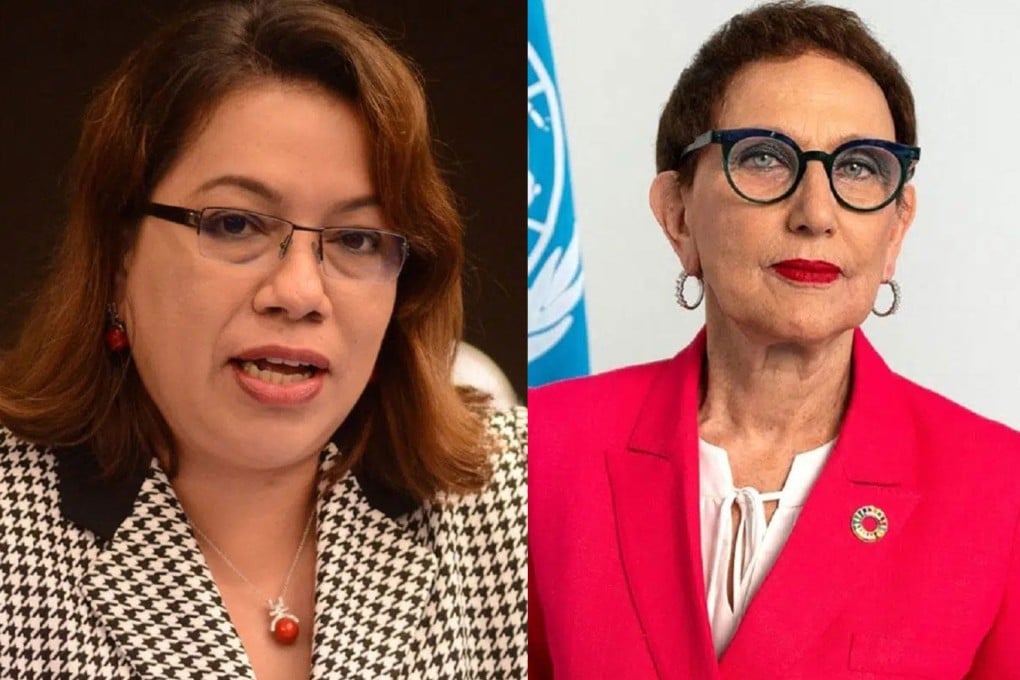
United Nations, Oct.1 (DPnet).– Security Council votes are increasingly leaning in favor of Rebeca Grynspan (right in the photo). The results of the 4th straw poll (Sept.29) were as follows:
Rebeca Grynspan (Costa Rica)
10 Encourage, 3 Discourage, 2 No Opinion
Carolyn Rodrigues-Birkett (Guyana)
8 Encourage, 6 Discourage, 1 No Opinion
Rafael Grossi (Argentina)
8 Encourage, 7 Discourage
Therefore, the election process remains firmly in the hands of the UN Security Council. The 193-member General Assembly only votes after the Security Council delivers a formal, singular nominee.
Meanwhile, the Security Council will continue running informal straw polls to narrow down the field until it may recommend one to the General Assembly.
What happens next: The Security Council will hold further rounds of straw polls. Crucially, they have not yet shifted to using colored ballots. Colored ballots are used to explicitly reveal if any of the five permanent, veto-wielding members (the US, China, Russia, the UK, or France) intend to veto a candidate. Reports have leaked that China is vetoing the three candidates but is reconsidering approving one of the two female candidates.
The Security Council must continue polling until a candidate emerges who secures at least nine affirmative votes and avoids a veto from any of the five permanent members.
But across the field, one gap is striking.
Candidates repeatedly promise to listen to people. To consult civil society. To engage youth. To make the UN more people-centred.Very few explain how people might actually acquire power.
Where is the right of citizens to put an issue on the UN agenda? Where are permanent mechanisms for citizen deliberation? Where is democratic representation beyond governments? Where is the commitment to ensuring that civil society participation does not depend on the goodwill of Member States? The next Secretary-General should answer those questions.
The election for the next UN Secretary-General has failed to find a consensus candidate after six preliminary votes, with a female minister from the United Arab Emirates (UAE) late entering the race. Attention is focused on whether the emergence of a new candidate can break the deadlock, as existing candidates have all faced opposition from permanent members of the Security Council.
According to the UN on October 21, the UAE officially recommended Lana Nusseibeh, 48, Minister of State, as a candidate for the position. UAE President Mohamed bin Zayed Al Nahyan emphasized Nusseibeh’s UN experience, judgment on international issues, and diplomatic achievements in a letter to the UN General Assembly and Security Council chairs.
It was revealed that no candidate avoided opposition from permanent members. Rebeca Grynspan, former Costa Rican vice president and the frontrunner with nine votes, faced opposition from two permanent members. Carolyn Rodrigues-Birkett, Guyana’s ambassador to the UN, and Rafael Grossi, Director General of the International Atomic Energy Agency (IAEA), each secured eight votes but were opposed by two permanent members. Other candidates faced opposition from at least three permanent members. Former Senegalese President Macky Sall later withdrew, and Lana Nusseibeh’s entry brought the race back to seven candidates.