| The World Bank Group mobilized a record $112 billion in private capital and $25 billion in guarantees in FY26, while outlining ways to bring more investment to emerging markets. The World Bank Group launched a new strategy using data and digitalization to help MSMEs access finance, reach new markets, create jobs, and grow. |
Managing Director Georgieva pointed out that the global economy faces risks of soaring debt and AI disrupting labor....
In closing the main forum, Georgieva quoted a royal address by His Majesty King Bhumibol Adulyadej (Rama IX), which stated:
"Benefits and success do not happen by themselves; they must be gradually cultivated, accumulated, and strengthened over time."
This teaching is the essence of global cooperation, and the InternationalMonetary Fund (IMF) will take this insight into its work for people around the world.
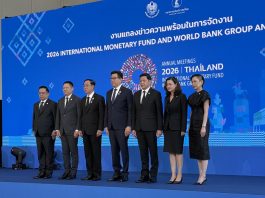 Bangkok, Oct. 18 (DPnet).– The 2026 Annual Meeting brought global leaders together in Bangkok, October 12–18, to discuss jobs, investment, growth, and practical development solutions. This IMF–World Bank Group Annual Meetings 2026 concluded successfully today, sending important signals about the direction of the global economy amidst technological shifts and a new geopolitical order.
The Annual Meetings Plenary opened with a vibrant celebration of Thai music and dance, followed by remarks from Annual Meetings Chairman Carlos Carvallo Spalding, President of the Central Bank of Paraguay, and IMF Managing Director Kristalina Georgieva.
World Bank Group President, Ajay Banga, outlined a development model centered on creating jobs at scale by bringing together public finance, private investment, philanthropy, and technology around country priorities. He highlighted progress in mobilizing private capital, expanding access to energy, health, and water, supporting MSMEs, and putting practical AI to work. 
As a leader of a global financial institution, Kristalina Georgieva, Managing Director of the IMF, conveyed profound perspectives, visions, and warnings reflecting both the opportunities and risks that countries face together. The key points and conclusions from the meeting are as follows:
1) The global economy: “Hope and Concern”
- The global economy remains resilient and continues to grow amidst repeated shocks, with Asia and the influx of investment in AI acting as engines supporting this growth.
– AI is like a “slow-moving tsunami” that is transforming the labor market structure, especially entry-level jobs for younger generations, and risks widening the inequality gap.
2) Warning: Global public debt to reach 100%.
-Global public debt is rising rapidly and is projected to reach 100% of global GDP by the end of this decade.
-The global economy is likened to a "ship navigating through stormy seas," finding it increasingly difficult to steer clear of crises because it is weighed down by debt and interest rates that remain high for longer than expected (Higher for Longer).
- Calling on governments worldwide to "repair their fiscal houses before the cracks widen."
3) Send the message to major economies.
-The United States needs to control its fiscal balance and accelerate savings.
-China is restructuring from state subsidies to promoting domestic consumption and welfare systems.
-Europe is accelerating innovation and capital market centralization to avoid falling behind.
4) Bringing the teachings of King Rama IX back to Washington, DC.
 -During the conference, Kristalina Georgieva interestingly used the analogy of "racing" to reflect the immense speed and lack of control of AI technology.
"We're on the racetrack now, but the important question is, where do we place the barriers to ensure that if a race car goes out of control on a corner, it doesn't bounce off and hit and kill innocent people?".
On October 13, World Bank Group leaders joined investors, regulators, and development partners to explore how to mobilize more private capital. Discussions highlighted how governments, development institutions, and the private sector can work together to build investable project pipelines, share risk, expand local-currency financing, and deepen domestic capital markets.
Drawing on examples from infrastructure, energy, and small business financing, speakers explored how successful approaches can move beyond individual transactions to scalable investment models that support businesses, build infrastructure, and create jobs.
The United Arab Emirates (UAE) has formally signed the agreement to host the 2029 annual meetings of the World Bank and International Monetary Fund (IMF) in Abu Dhabi.
The deal, signed at the conclusion of the IMF and the World Bank 2026 annual meetings in Thailand, is a mark of growing international confidence in the UAE’s economic and financial ecosystem, the UAE Ministry of Finance said in a statement on Sunday.