The world is in its most precarious geopolitical environment since World War 2. The big question is whether or not WW3 will go nuclear. And if it does, will it be just some relatively small-yield tactical bombs used against military formations? Or will it get out of control, with strategic weapons used against cities? Either is possible.
Let's just hope NATO doesn't back the Russians into a corner, the Zelensky regime stays out of NATO, and the Israelis don't go nuclear against the Iranians.
As WW3 develops, I don't think there's any question it will have significant cyber aspects as well. The whole world runs on computers. Computers control utilities, transport, the banking system, communications, commerce, distribution, and everything else. If computer networks are massively hacked it could collapse civilization. The result could be mass starvation after a couple of weeks.
And, of course, there's a real possibility of biological warfare. If any of these things happen, it increases the odds of all of them happening. 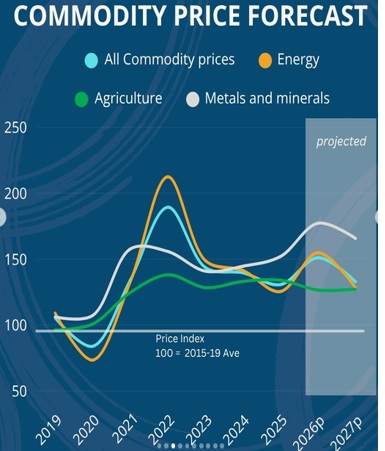
So price movements in the commodity and financial markets will likely be the least of our problems (see chart). Let's assume, therefore, that things don't go beyond a regional level.
One current difference in how WW3 is evolving is that almost all of the governments of the world are already bankrupt. Historically, governments only go bankrupt during or after wars; this time they're all bankrupt before the war has really even started. They're all welfare states with huge fixed domestic spending. They already have an unrepayable amount of debt. That's never been the case previously.
Along with unsupportable debt, and high levels of currency debasement, taxes are already at the 40%, 50% or 60% level for most countries. Before World War I and even before World War II, taxes, inflation, and debt were only a tiny fraction of present levels. Governments could access huge resources. Even though the world is much richer, it hardly seems possible now. They're already running on empty.
WW3 will be limited by the financial ability of governments to fight. There's a bright side, I suppose, to most of the world's governments being financially unstable or on the ragged edge of bankruptcy, very much like the US government.
It may serve to limit the damage they can do. But, then, I'm an eternal optimist…
On the other hand, war typically influence the prices and availability of critical commodities. They'll go higher. Throughout history, governments have debased their currencies to finance their wars. Prices of commodities always rise, with prices for war material leading the way.
But this war isn't likely to be as materiel-intensive as wars in the past. Technology and chips will replace a lot of steel, aluminum, and copper, which is just as well since it takes years for new mines to produce metals.
It's hard to say exactly how any chaotic situation will evolve, and war is pure chaos. But if I'm right that WW3 is not going to be as materiel intensive as past wars, then maybe we should look at luxury goods as opposed to bulk commodities. In the War Between the States, Southern blockade runners carried lots of coffee, tea, and other luxury items in addition to arms. Wars always create distortions in the ways people act, and the ways things are used. When the war is over, one thing that's certain is that the economy will snap back to sustainable patterns. But there's no point in planning that far ahead.
Oil will certainly be a major fulcrum, as it was in WW I & II. Most of the world's oil is produced in just a few places and shipped through just a few chokepoints. Demand will go up since it's the densest kind of energy there is, but production, refining, and shipping facilities will be destroyed; at some point soon, we should see all the hydrocarbons skyrocket. In addition, governments always put on both wage and price controls and foreign exchange controls during wartime. These things will create shortages for civilians and will be most inconvenient.
past wars were comparatively local matters. Easily available nearby materials were used to fight the war. But now everything is shipped around the globe. Supply lines are now both highly complex and critically important to winning. And very easily cut with today's military technology.
Some parts of the world are going to be hurt a lot more than others.
Africa has been largely left out of past wars. It survives by importing capital, technology, and food. In return, advanced countries extract their raw materials. WW3 will cut off both. Since local governments there now have serious armies and weapons, the continent could turn into a giant "no-go" zone. Africa could experience a wholesale collapse of civilization, featuring the export of scores of millions of migrants to Europe.
On the other hand, South America is likely to do relatively well. It's at the end of the road. It wasn't involved in either World War I or World War II and profited from that fact. It has local industry as well as raw materials. I suspect South America will be a relative beneficiary of WW3.
Europe will be a big loser. Not only is it de-industrializing, but it's likely to turn into a battlefield again.
The US will almost certainly use its bloated gold-plated military to intervene absolutely everywhere. The consequences for US citizens won't be good.

|
** Doug Casey is a best-selling author, world-renowned speculator, and libertarian philosopher who advocates free trade. He is a provider of subscription financial analysis about markets. His International Man blog is accessible here → https://internationalman.com/. He and his team released this video on his proven strategy—including the best way to get a second passport, offshore bank account, and much more. |