The truth about the digital Euro
- Pedro Gómez Martin-Romo
-
 Topic Author
- Offline
- Administrator
-

- Posts: 16
- Thanks: 1
The truth about the digital Euro
29 May 2026 13:41 - 02 Jun 2026 09:27
The truth about the digital Euro
Madrid, April 9, 2026
Confusion surrounding the digital euro.There is a great deal of misunderstanding surrounding the implications of the digital euro. This confusion has been partly generated by imprecise opinions from various economists who have equated the uses of central bank digital currencies (CBDCs) in other countries with the European project. They have also failed to provide a scientific justification for the usefulness or ineffectiveness of the digital euro. As we will see, the digital euro, as designed and contrary to popular belief, maintains a level of confidentiality equal to that of current physical currency. The solutions offered by the digital euro to overcome concerns about connectivity and confidentiality issues for offline wallets are truly excellent and surprising. However, we will also examine the reasons why the use of this currency is proving irrelevant in many countries and, foreseeably, will be irrelevant in Europe, both from a monetary and social perspective.
A brief history of “metallic-digital”
Given the evolution of communications, technology, and changing customs, it is foreseeable that, in the not-too-distant future, all cash will be replaced by electronic money. In Sweden, recent studies place cash payments in stores at around 5%, and in Norway around 3%. This evolution has been brewing since the end of the last century, with the emergence of the first private payment applications such as DigiCash and PayPal. By 2002, PayPal was already a very popular payment platform in the US. It is surprising to note that, twenty years ago in Kenya, the M-Pesa application from the communications company Safaricom already enabled mass mobile payments without traditional banks. In China, private applications like Alipay and WeChat Pay were already dominating QR code payments by the end of 2015.
In 2015, the emergence of Ethereum, the popularity of Bitcoin, and the growth of private payment applications began to seriously worry the market, accelerating the entry of banking into the scene.
Largely in response to PayPal and other payment methods, in 2016, CaixaBank, BBVA, Banco Santander, Banco Sabadell, and others launched the Bizum project. In total, more than 20 banks and financial sector associations in Spain participated. The management of this payment method is private, and the Central Bank has no involvement. Also in 2016, the National Payments Corporation of India, an entity promoted by the Reserve Bank of India and the country's banking association, launched the Unified Payments Interface application.
In 2019, the Central Bank of Russia launched its National Payment Card System (NSPK), which allows instant transfers between banks using a phone number or a simple QR code.
As a result of all these developments, credit and debit cards (Visa, Mastercard, American Express, etc.) saw their oligopoly threatened. It's important to note that, even today in Spain, despite their diminished prominence, credit and debit card payments are estimated to represent 50% of the total, followed by digital wallets (Apple Pay, Google Pay, PayPal, etc.) at 20%, bank transfers at 20%, and finally cash at 10%.
As a consequence of the anticipated loss of market share for credit cards, in June 2019, a consortium of large technology and financial companies, including Facebook, Visa, Mastercard, PayPal, Uber, Spotify, and Amazon (which was not a founding member), presented the Libra project. The Libra project aimed to create a global digital currency that could be easily used worldwide, something like an “internet currency” managed by a consortium of companies led by Facebook (Meta Platforms). We could say that, for the first 20 years of this century, the struggle for control of payment methods was limited to technology companies versus financial companies. The State remained, more or less, on the sidelines of the struggle it witnessed. But Libra represented crossing the red line of controlling monetary issuance, involving the State in the fight. Due to the intense pressure faced by the organizing companies, the Libra project was definitively abandoned in 2022.
The ongoing battle to control payment methods and the issuance of foreign currency had been a source of concern for central banks, but Libra was the final straw. If a state loses its monetary leadership, it squanders a significant portion of its national sovereignty and its very reason for being. The 2019 pandemic and Libra ultimately accelerated the adoption of electronic payments and brought central banks into the spotlight.
Thus, in 2019, the US Federal Reserve began to discuss digital currencies more seriously. That same year, Fed Chairman Jerome Powell confirmed to Congress that they were exploring the possibility of a “digital dollar.” In August 2020, Powell stated that the Fed was actively researching a CBDC, emphasizing that it was more important “to get it right than to be first.” In January 2022, the Fed published an official report titled Money and Payments: The US Dollar in the Age of Digital Transformation, which outlined the pros and cons of a CBDC, opened the public debate, but did not reach a final decision.
In October 2020, the ECB published the first official report on its future Central Bank Digital Currency, or digital euro, laying the theoretical and technical groundwork for the project. The blocking of Visa and Mastercard to Russia in 2022 following the invasion of Ukraine has also been a cause for alarm for many central banks. As in Spain, in many countries more than 70% of everyday payments rely on American credit card and digital wallet companies.
Globally, all these decisions are generating much debate in public opinion because they combine technological innovation with important geopolitical, economic, and social implications.
One of the major criticisms leveled against the advancement of central bank digital currencies (CBDCs) is the loss of privacy. This raises several questions. In the European context, who will be responsible for approving CBDC regulations? With a digital euro, would we truly experience a loss of privacy? Are we mistakenly conflating the concept of electronic currency issuance with the electronic payment system? In other words, why do we need a digital euro if we already have Bizum? What advantages and disadvantages does the new currency offer? Would serializing electronic money be preferable to tokenizing it? Is this the end of credit and debit cards? What do commercial banks think of this strategy? Should the issuance of currency and the control of the payment method be combined within the same entity?
Means of payment and money issuance.
We must always keep in mind that payment methods or applications, such as Bizum, are one thing, and electronic monetary issuance is quite another. If control of payment methods and currency issuance is concentrated in the hands of the Central Bank, the risk of loss of confidentiality is high.
Conversely, if the payment method is managed by private banks, as is currently the case with Bizum, the introduction of a CBDC would not significantly alter the existing situation. In other words, if the Central Bank limits itself, as it does today, to maintaining exclusively commercial relationships with banking entities, and not directly with citizens, the situation remains virtually unchanged with the emergence of a CBDC.
In 2020, the Central Bank of Brazil launched PIX, one of the most interesting payment systems to analyze due to its high level of confidentiality. PIX is a public infrastructure created and managed directly by the Central Bank of Brazil, but it allows users to maintain their current level of privacy. While Bizum requires a mobile phone number to use the application, PIX requires two pieces of information: first, as with Bizum, your bank account details, and then a mobile number, email address, CPF (Brazilian national identity card number), or a random key (an alphanumeric code). With the random key or email address, neither the central bank nor PIX administrators, without judicial authorization, can access any information whatsoever about the account holder. The recipient of the money also has no access. It's important to note that when you make a payment to a store owner using Bizum, the recipient sees your name and the last few digits of your phone number if you are not saved in their contacts. This is because Bizum was designed for peer-to-peer payments. Furthermore, with Bizum, since our phone number is linked to an account, we are more vulnerable in the event of a data breach or a hack of the Bizum app than with PIX. It's important to note that neither Bizum nor PIX creates an account with the Central Bank; therefore, the PIX app, like Bizum, only acts as a monetary intermediary. With PIX, a traditional bank account is not strictly necessary. Although the most common way is to link it to a checking or savings account, the system also works with digital accounts, virtual wallets, and payment institutions (fintechs) authorized by the Central Bank of Brazil.
The level of confidentiality offered by PIX has made it a very popular app in Brazil, to the point that many places no longer accept cash or credit/debit cards. Many businesses, from large stores to street vendors, display a QR code that customers scan with their banking app to pay instantly. Platforms like Mercado Pago either AstroPay allow foreigners to use PIX by loading funds from their own local accounts. Some banks in neighboring countries, such as Banco Patagonia in Argentina, they already integrate the option to pay with PIX directly from the mobile to facilitate purchases in Brazil.
The emergence of PIX is putting pressure on the credit card business, including companies like Visa and Mastercard. The federal agency responsible for the U.S. government's international trade policy had included PIX in itsinvestigationfor “harming the competitiveness of U.S. companies operating in those sectors,” a veiled reference to the credit card corporations VISA and Mastercard, from which PIX has wrested the lead in electronic payments in Brazil. Nobel laureate economist Paul Krugman wrote aarticlein defense of PIX, defined this technology as the money of the future: “PIX transactions are almost instantaneous, taking 3 seconds, compared to two days for debit cards and 28 days for credit cards. Costs are low: the system is free for individuals and charges just 0.33% of the transferred value for businesses, compared to 1.13% for debit cards and 2.34% for credit cards. International criticism and pressure led President Lula to speak out forcefully: "I'm not going to make people change or PIX“.
How the digital euro works.
The future digital euro is designed as follows. Citizens could open a digital wallet with the ECB through their bank, although this will not be mandatory. All management of this wallet will be handled through your usual bank or authorized intermediaries; therefore, the virtual wallet will be integrated into your bank's services. It will be a kind of NEW account that will appear in your bank's app.
If a citizen has accounts with several banks, they can have multiple digital wallets. Citizens can transfer money from their bank account to the digital wallet, but up to a limit, estimated at €3,000. If you have two wallets, the sum of their balances cannot exceed this overall limit. To make this possible, there will most likely be a central database (managed by the ECB or the Eurosystem) that links all of a citizen's wallets to a single identifier. In fact, some analyses of the project indicate this. When you try to open a second wallet, the system will verify that the overall limit has not been exceeded.
To easily manage this limit for the user, the digital euro includes an automatic mechanism called a waterfall. If you receive a payment and exceed the legal limit, the system will activate a "reverse waterfall," and the excess will be automatically transferred to your linked traditional bank account, where it is no longer digital euros but conventional bank money. If you want to pay for something and don't have enough balance, the system activates the waterfall and takes funds from your bank account to complete the transaction. In practice, for the user, the experience is like having a digital wallet with a capacity limit, which is never exceeded thanks to this automatic system.
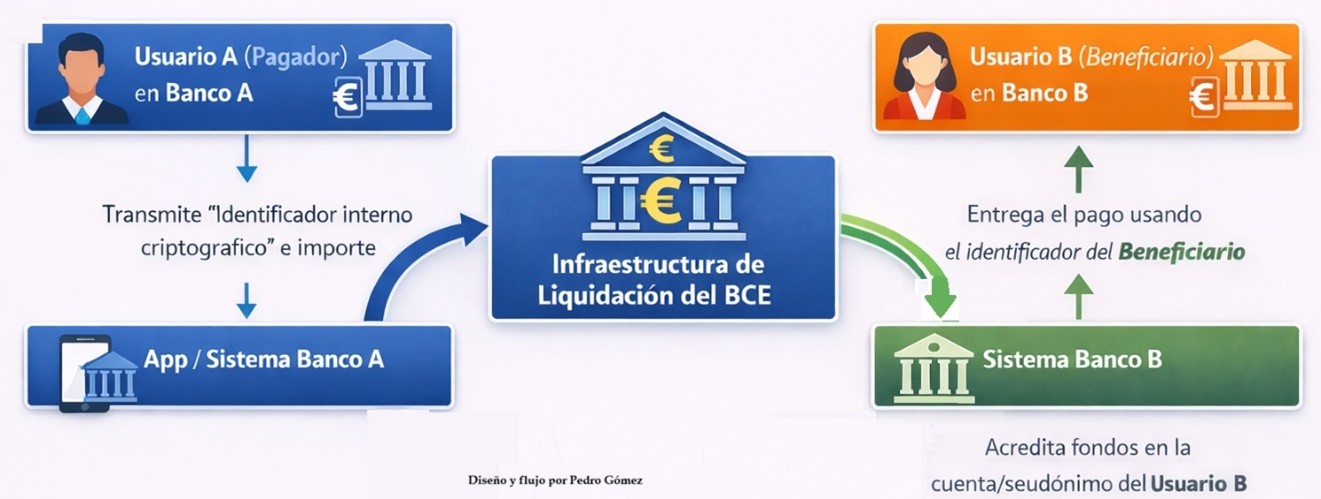
The ECB will receive the citizen's data in pseudonymized form; that is, the wallet is linked to a technical identifier or encrypted code. Therefore, the ECB will not know the name of the citizen or the company that owns the wallet. When a digital euro transfer is made between two wallets at different banks, the intermediary banks will not transmit the sender's and recipient's personal data (name, address, etc.) to the ECB. The system is designed so that personal information is not part of the transaction settled on the ECB's central infrastructure. The central bank will not be able to see, track, or link balances or payments between individuals. Broadly speaking, the flow would work as follows:
Hetrilogueand the legal status of the digital euro.
As I mentioned, in October 2020 the ECB published the first official report on its future Central Bank Digital Currency. In July 2021, the ECB Governing Council formally decided to launch the digital euro project. Although the ECB has the exclusive power to authorize the issuance of money, current legislation does not allow the ECB to issue a digital currency. Therefore, it needs a new legal framework involving the European Parliament and the European Commission: the trilogue.
On June 28, 2023, the European Commission presented the “Single Currency Package“ (Single Currency Package), which included the proposal for a digital euro. This package contained two main legislative proposals: The Proposal for a Regulation on the digital euro (COM 2023 369 final), which establishes the legal framework for the possible introduction of the digital euro as a complement to cash, and the Proposed Regulation on Cash (COM 2023 368 final), which seeks to safeguard the role of cash, guaranteeing its wide acceptance and accessibility.
Differences between Parliament and the Council of Ministers
- At the end of 2025, both the European Parliament and the EU Council of Ministers published their negotiating positions on the digital euro. Although they share the goal of creating a legal framework, the two institutions disagreed on key points regarding the scope and nature of the future digital currency. The main difference between the two positions centers on the functional scope of the digital euro and its relationship with private payment solutions. The EU Council demands that the digital euro be available in both its online and offline forms from day one. The European Parliament's rapporteur, Fernando Navarrete, proposed a two-phase approach. The first phase would involve initially launching the offline version as a form of "digital cash" offering maximum privacy. The development of the second phase would be contingent upon the European Commission demonstrating that no viable pan-European private retail payment solution exists. The aim is to avoid hindering European private initiatives such as the European Payment Initiative (EPI).
- In addition to this main divergence, there are other important details on which the positions are also not aligned. The European Parliament's proposal seeks to strengthen its own role in the process, demanding an explicit resolution of approval from the European Parliament before the digital euro can be issued. The Council's mandate does not include this explicit requirement.
- Secondly, both institutions agree on establishing a holding limit on the amount of digital euros a citizen can hold across all their digital wallets (holding limits) to avoid risks of financial instability. However, there is debate about who should set this limit, the ECB or the Governing Council, and its amount, which is one of the thorniest points of the negotiation. There are also disagreements regarding the limit under consideration. While the ECB proposes a limit of €3,000, as its analysis indicates that this figure would not pose a risk to financial stability, commercial banks prefer a lower limit of €1,000 to prevent a massive outflow of bank deposits into ECB digital wallets that could negatively impact their business.
Agreement between Parliament and Council on the digital euro
Despite these differences, there are key points where both institutions show clear consensus. Both the Council and Parliament emphasize the need for a high degree of privacy, especially for offline transactions, which aim to emulate the confidentiality of cash. They also agree on consumer protection. They concur that basic services, such as opening and closing accounts, making payments, etc., should be free for users, although providers may charge for value-added services. They also agree on a transitional period of at least five years with regulated fees for merchants. Furthermore, as part of the Single Currency Package, both institutions support measures to protect the use of cash as legal tender, guaranteeing its acceptance throughout the EU. There is broad agreement that, once the legislation is approved, the goal is for the ECB to be able to issue the digital euro, which should be operational by 2029.
With positions now defined, the legislative process enters its most decisive phase. The Council concluded its mandate (December 2025), and the European Parliament is now expected to formalize its own mandate to begin official negotiations with the Commission in 2026. The ECB has indicated that it could launch a pilot phase in 2027 to test the technology and use cases. The target year for the potential issuance and circulation of the digital euro, if all the previous steps are successfully completed, is 2029. In short, the digital euro project has gone from being a Commission proposal to a matter of intense political debate. The main variations in the texts reflect a fundamental discussion about the role a central bank digital currency should play: whether it should be a universal tool from the outset (Council's position) or a more limited solution serving as a "Plan B" to avoid stifling European private innovation (Parliament's position).
Physical money vs. offline payments (the big breakthrough).
This system is truly a substitute for physical money. One of the biggest myths about the risks of the digital euro is that...Connectivity and confidentiality problems. Due to the major blackout electric on April 28, 2025, the power outage that left more than 50 million people in the Iberian Peninsula without electricity left many struggling to get to lunch or home because they had no cash. This incident has raised doubts about the technological capacity to replace physical money. But, rather than a drawback, this is a major advantage of the digital euro compared to the current Bizum and other similar applications.
For the digital euro to function like cash, the European Central Bank (ECB) has designed an offline payment method that also prioritizes privacy. Unlike a regular bank transfer or card payment, where the bank validates the transaction on its servers, offline payments are made directly between two devices (mobile phones or smart cards) using proximity technology (NFC or Bluetooth). Neither the Central Bank nor your commercial bank will see what you bought, where you bought it, or who you paid.
The plan is for a person to have a prepaid card, which they can use to pay in stores, with the balance decreasing over time, leaving no record of where the owner spent the money. Naturally, if you lose the card, you lose the remaining balance.Neither the Central Bank nor your commercial bank will see what you bought, where you bought it, or who you paid. The transaction details won't be stored on the chips of the devices involved in the payment. It's like having an account on your phone or prepaid card where only you can access the remaining balance.Consequently, it's the closest thing to handing over a €50 note. To prevent fraud, when your mobile device connects to your bank to top up your balance or to report changes, it will only display the current balance, not the details of individual purchases. To prevent this privacy from being used for large-scale money laundering, there will be a maximum limit on the amount of money you can carry offline, likely a few hundred euros. There will also be a limit on the amount per transaction; for example, you won't be able to pay for a €20,000 car offline. To top up your offline balance, you'll have to transfer money from your online bank account to your offline wallet on your phone. At that point, your bank knows you've withdrawn money, but loses track of how you spend it from then on. One of the amendments in the Parliament's draft explicitly proposes that individuals cannot have more than one device for the offline digital euro. The risk of theft or physical loss in the offline mode exists and is very similar to that of conventional cash. Since the money is stored directly on your device (mobile phone or smart card) to guarantee privacy, security depends on that physical medium. This will not be convenient.Accumulate a significant offline balance if you're not going to use it. In short, the offline digital euro preserves absolute confidentiality up to certain amounts and is the true substitute for physical money.
Therefore, the State, without judicial authorization, will not know the destination of online funds, and only by legally gaining control of your mobile device could they discover how you spent your offline wallet. We would be in a situation of confidentiality very similar to the current one.
Advantages of the digital euro
1. The main advantage of the digital euro is offline payments, as already discussed.
2. Avoid using counterfeit paper money. The more we use electronic payment methods, the harder it is for counterfeiters to introduce fake money. Keep in mind that Interpol seized 1.2 billion euros in counterfeit currency in 2025 in a single operation before they reached the market.
3. Some believe that a digital euro would allow for instant transactions with lower fees, even internationally. It's worth reminding readers that for small amounts, we already have Bizum, and the maximum amount you can transfer within Europe is €3,000. Bizum is currently expanding internationally with other equivalent payment networks, such as Bancomat (Italy), MB Way (Portugal), and Vipps MobilePay (Nordic countries). Bizum is part of alliances like EuroPA and the European Payments Initiative (EPI). If the goal is to be able to send money to someone in another European country in a few years, Bizum might allow you to do so much sooner. Parliament has proposed allowing merchants outside the eurozone to receive payments in digital euros. This means that a business in a country that doesn't use the euro (like the UK or Switzerland) could receive payments in this digital currency, but wouldn't be able to hold onto it; the system would automatically convert or transfer it, preventing the merchant from accumulating it.
4. Geopolitically speaking, the eurozone needs to increase its independence from American companies, which control 70% of the means of payment.
5. The digital euro could aid economic analysis. Visa and Mastercard possess a goldmine of consumer data: where you shop, how much you spend, and how often. By using national systems like PIX or Bizum, this data remains within the country's banking ecosystem, leaving card networks "blind" to consumer behavior. If Bizum were to increase its transfer limits, expand internationally, and adapt to the business environment, the ECB could access this information through Bizum. Naturally, this information would need to maintain the confidentiality of personal data. Consequently, if Bizum evolves, I don't consider statistical data alone a compelling argument for justifying the need for the digital euro.
6. Greater financial inclusion. Some argue that CBDCs would allow for greater financial inclusion because people without bank accounts could access digital money from their mobile phones. In countries like Brazil and Kenya, millions of people lacked the credit history to obtain a Visa card. With the new apps, they only need a free digital account and a mobile phone. This has brought banking services to the population, bypassing the "card era." However, we haven't needed CBDCs to achieve financial inclusion, and besides, there are few unbanked people in Europe. Therefore, this argument is also weak.
7. Security. Some justify CBDCs because they are more secure than many cryptocurrencies like Bitcoin and even euro accounts, since their balance is guaranteed by the ECB. This is true, but it's also true that small savers also have their deposits in their traditional bank accounts guaranteed up to €3,000 (the CBDC wallet limit) by the deposit guarantee fund.
8. Greater stability. According to some, CBDCs, being backed by central banks, are more stable than many cryptocurrencies like Bitcoin, which can be highly volatile. Monetary stability doesn't depend on the personal backing of the central bank in question, but rather on the management of primary and secondary monetary expansion that the central bank tolerates, as well as the official interest rate. Furthermore, we are talking about relatively small amounts compared to the total money supply in circulation in the European Union. Since the ECB will not pay interest on these wallets, it will be advantageous for small users to keep only a small amount in their digital wallet. Thanks to the previously explained cascading mechanism, when a payment is due and there are insufficient funds, the difference will be debited from the interest-bearing account.
Therefore, this argument doesn't seem like a valid reason to me either.
Disadvantages of the digital euro
1. Excessive state control. Critics say that, in extreme scenarios, the state could restrict how money is spent, for example, by blocking certain payments. Everything will depend on the specific CBDC model. With the current design of the digital euro, the European Central Bank is not expected to receive all the personal data from every everyday payment. Therefore, the ECB will not know who owns the euros.The Central Bank will only keep track of the monetary blocks of digital euros transferred between entities, without receiving the names of the parties involved.
2. Impact on traditional banks. Some, not understanding how the digital euro works, believe that if people deposit money directly with the central bank, institutions like Banco Santander could lose deposits, affecting the financial system. This, as we've seen, is incorrect, given that there's a limit per wallet. From a commission perspective, Bizum users currently don't pay commissions, and if this application becomes international, banks would lose that part of their international business, just as they would with the digital euro. In both scenarios, banks will start charging us commissions one way or another. Remember that PIX Brazil charges 0.33% per transaction for businesses.
3. Technological and cyberattack risks. I consider it highly unlikely that a centralized system, with multiple backup systems and serial numbers, would be subject to cyberattacks, data loss, or data manipulation. On the contrary, every year we receive a couple of news reports about Bitcoin wallet thefts, which are unrecoverable because there is no authority to back and ensure the system's security.
4. Digital exclusion. The digital euro is criticized because older people or those without access to technology could be at a disadvantage. This is true, but I believe this group is shrinking every day. The generations entering their senior years are increasingly familiar with this type of transaction.
Myths about the digital euro
Many YouTubers, both domestic and international, have spread inaccurate information about the digital euro. In many cases, when referring to the digital euro, they spoke about the dangers of how other central banks use, or might use, CBDCs, which has contributed to the spread of misconceptions about the digital euro. Economists Daniel Lacalle, Marc Vidal, Juan Ramón Rallo either Guy Turner, all have left too many doors open in their videos and interviews. Summary below “the dangers of the digital euro” of "the spy coin that nobody asked for“ which some describe:
- According to some, the ECB will be able to issue unlimited amounts of CBDCs. Currently, there are no technical plans for the ECB to issue digital euros. We are placing excessive emphasis on this aspect, when, since its inception, the ECB has been able to issue unlimited amounts of non-digital euros to uphold its statutory objectives. What should concern us is not the medium, but the ECB's issuing power. Therefore, we should not focus on the medium itself, the digital euro, but rather on the abnormal autonomy the institution holds. Following Milton Friedman, who advocated for an independent central bank subject to predetermined issuance rules, the only monetary theory that meets both conditions is the Interest Pattern. Therefore, rather than dismissing the digital euro, we should question the current European monetary issuance system, which sometimes degenerates into enormous sums of excess monetary capacity, which is why the ECB has been operating at a loss for three years.The best monetary policy is to respect the Principle of Progressive Growth of the Money Supply. For the reader to learn in more detail how this monetary system works and how to supply money according to the level of economic activity, I refer you to my article published in La Vanguardia: The Interest Pattern in the 21st Century ( English version here ) The Pattern gives the national currency endogenous credibility, allowing the interest rate and the exchange rate to evolve naturally.
Programmable or limitable money.
Daniel Lacalle, Marc Vidal, Juan Ramón Rallo and others have repeatedly warned about the technical capacity of central bank digital currencies to be programmable or have their use limited, but there is a key distinction between what the technology allows and what the European Central Bank has legally promised to do. Both economists warn us that, in the future, the digital euro has the technical potential to be "programmable money" in many respects (money that will eventually expire). Thus, they have alerted us that the digital euro could have an expiration date, forcing us into mandatory consumption by the ECB during times of economic crisis. They have also suggested that governments could restrict purchases based on ideological, medical, or environmental criteria (such as CO2 limits). They argue that, even if they tell us today that they won't, the mere existence of the technical tool is a risk to individual freedom. They have also mentioned that we could be charged fines or taxes automatically. This is not new, given that, nowadays, when a citizen fails to meet their tax obligations or defaults on a penalty, the authorities can freeze their bank accounts. The ECB could also impose negative interest rates on your digital wallets, etc. Faced with the opinions of these and many other economists, the official response from the ECB and the Bank of Spain was clear and firm. The current draft law expressly prohibits the digital euro from being programmable or having its use limited. The ECB defines the digital euro as “money, not a coupon.” Under no circumstances will the digital euro have an expiration date; it will maintain its value indefinitely, just like cash. Furthermore, its use will not be subject to restrictions. The legal framework establishes that the issuer cannot limit what products can be purchased or where the money can be spent. It is a matter of institutional trust versus technological capacity. Technologically, they are right that a digital currency could be programmed, as is already the case with some versions of the digital yuan in China.
However, legally, the ECB maintains that its current specific technical design prevents these functions in order to protect user sovereignty and privacy. In short, Lacalle, Rallo, and Vidal are not lying about the technical capabilities of this type of technology, but the official European design for the digital euro includes legal safeguards that, if upheld, would make what they describe impossible. Furthermore, if we want to get dramatic and optimistic, the Central Bank could also consider a series or issue of paper currency that is not exchanged for one of lower value or spent in commercial establishments before a certain date to be out of circulation, requiring these establishments to finally exchange it at the Central Bank for an updated series. It could also prevent cash payments for certain products, such as gasoline. If we let our imaginations run wild,the abuses that the State could commit against the population, through the digital euro or with paper money, could be curious and endless.
Moreover, many alarmists only highlight the negative aspects of a hypothetical digital euro. They fail to mention that, in a remote scenario of state intervention not foreseen in the current regulatory framework, the government, through the central bank, could provide direct monetary aid without intermediaries to certain social groups. For example, to people under lockdown, those affected by natural disasters, etc.
The digital Euro will not please anyone.
As proposed by European Parliament, i would be advisable for the development of the second phase (“online”). This would be contingent upon the European Commission demonstrating that no viable private pan-European payment solution exists. If the European Payment Initiative (EPI) can provide citizens with a “European Bizum,” it would seem reasonable to distribute responsibilities between the entity that, in the future, controls the means of payment (the EPI) and the one that issues the money (the ECB). Furthermore, the future “European Bizum” should be required to integrate an offline solution similar to the one currently proposed in the trilogue. Likewise, the final legislative framework and any future amendments should be approved by the European Parliament, and powers on this matter should not be delegated to the Council or the ECB. The responsibility for setting the limit for each digital wallet should be shared between the Council and the ECB.
As currently legally designed, the legal framework for the digital euro will satisfy no one. Its implementation will offer little added value to citizens. When a CBDC functions almost identically to existing digital money (cards, Bizum, etc.), there is no incentive to switch, especially if our bank pays interest on accumulated balances. And for businesses, the digital euro is shaping up to be just another payment channel, less expensive and more efficient, but not a new way to manage their treasury or accumulate balances. Perhaps for this reason, the Bahamas' Sand Dollar CBDC, launched in 2020, has seen extremely low adoption, less than 1% of the currency in circulation. For citizens, the Sand Dollar offers no clear advantages over cash or cards. Since it doesn't generate interest or offer discounts, people prefer to continue using what they already know.
The Central Bank will also be unhappy because it will not have firsthand access to consumer statistics unless it manages the second (online) phase of the project, and it should not be able to alter the regulatory framework approved by the European Parliament. However, if the ECB manages the second phase, private banks will see a large part of their business threatened, both in terms of fees and deposits. Furthermore, banks are already wary that the €3,000 limit could one day be increased and that the ECB could directly remunerate or inject money into digital wallets.
Nor will it satisfy monetarist academics, as we will have missed a great opportunity to advance in improving the money issuance system. A good monetary system should better control all electronic money through serial numbers for each electronic euro. We citizens often forget that, since electronic money is not serialized, commercial banks create electronic money by using customer deposits and deposits borrowed from the interbank market (secondary expansion). While it may be difficult to acknowledge this monetary flaw, when banks lend money beyond the deposit's maturity, they are creating money. For example, if a customer of Bank A deposits €100 for 90 days, and Bank A lends that deposit to one of its customers (customer A) for 360 days to pay a supplier (supplier
 , a customer of Bank B, when Bank B receives the money back as a deposit for another 90 days, it could lend it for 5 years (1800 days) to a customer B2. Or, if Bank B lends that money to a supplier C, a customer of Bank C, the money will have doubled without any control from the central bank. The first time for 270 days (360-90 days) and the second time for 1710 days (1800-90 days).

Similarly, if three banking entities lend money to each other, they will be creating money out of thin air, generating inflation, asset bubbles, and disrupting the entire economy.
As the Interest Standard monetary theory indicates, it would be crucial for the control of electronic money to, firstly, prohibit banks from using any type of deposit beyond the contract's maturity date and, secondly, to serialize the money. Only with judicial authorization could the traceability of the money be reconstructed, which would allow for a reduction in theFraud, the underground economy, money laundering, tax evasion, and corruption. All these activities would be more difficult to conceal.
Doing things halfway is pointless, and it takes courage and knowledge to do things properly. Perhaps for these reasons, countries like Swisse ither United Kingdom have said NO to CBDCs.
Pedro Gómez
Professor
Master's Degree in Financial Consulting and Insurance
Technical University of Valencia
-
Last edit: 02 Jun 2026 09:27 by Pedro Gómez Martin-Romo .
Reply to Pedro Gómez Martin-Romo
Moderators: Miguel Saludes, Abelardo Pérez García, Oílda del Castillo, Antonio Llaca, Efraín Infante, Pedro S. Campos, Héctor Caraballo
Time to create page: 0.165 seconds