The Interest Pattern in the 21st Century
- Pedro Gómez Martin-Romo
-
 Topic Author
- Offline
- Administrator
-

- Posts: 16
- Thanks: 1
The Interest Pattern in the 21st Century
29 May 2026 11:50 - 29 May 2026 16:55
The Interest Pattern or chaos.
The collapse of the financial system.
The collapse of the financial system.
Madrid, February 27, 2026
In search of the lost monetary anchor
The world is experiencing monetary exuberance and an abnormally benchmark interest rate. As a result of the large quantity of money issued, both the Federal Reserve and the European Central Bank have incurred substantial losses over the past three years. The Bank of England has also been operating at a loss since July 2022. The Reserve Bank of Australia has also been operating at a loss since 2022. How is this possible? More than 150 countries are grappling with monetary identity issues. By the end of 2023, the Federal Reserve and the European Central Bank had to support the Central Bank of Sweden to prevent the collapse of the Swedish krona. According to my latest data, Turkey has lost more than $60 billion in reserves over the past 10 years, reserves that were used to stabilise the lira's exchange rate. The fiat currency system has become incomprehensible to most economists. Everything has an origin or reason for being, but the origin of these phenomena violates the most basic principles of fairness.
Due to the current monetary situation, we all feel that our purchasing power is decreasing and that it is becoming increasingly difficult to support a family in any country in the world. Is the monetary system ultimately responsible for this situation?
In this article, I will argue that just as it is hard for us to grasp how England became the world's leading power at the end of the 18th century with over 700 monopolies controlling its economy (for pins, bricks, tobacco, cotton, etc.), it will be challenging for 24th century economists to comprehend how our economy functions. The monetary system must undergo a transformation on a par with those of the last three hundred years; otherwise, chaos will ensue.
In order to understand how the monetary system — the operating system of the economy — should function, it is helpful to think of the economy as being like our body, in that it needs an amount of monetary energy proportional to its level of activity. The greater the activity, the greater the increase in monetary energy. If the velocity of money slows, the velocity of money issuance must also slow. Like the economy, our body never stops, barring a fatal outcome, but the pace of activity decreases from day to night, throughout the week and throughout the year. If we overeat, we suffer inflation; conversely, we experience deflation. This is why it is important to understand our level of activity. But who and how does this get determined in today's economy?
For five hundred years, humankind has striven to design a flawless monetary system that determines the optimal amount of money in circulation, but has failed. An optimal monetary system is neutral, capillary and sequential, with a store of value and in accordance with market demand.
There are different fiduciary proposals that try to strengthen the existing system, such as Modern Monetary Theory (MMT), but they fail to realise that any changes made to the existing system will be insufficient to efficiently and effectively meet the needs of increasingly complex economic activity.
The only non-fiat monetary theory that meets the aforementioned requirements is The Interest Pattern. Thanks to this issuance system, humankind will be able to inject money according to market needs in the future, enabling the four fundamental variables of the economy (4FVs) to evolve proportionally. The healthiest economy is not necessarily the one that grows the most, but rather the one that best harmonises the growth of its four fundamental variables: capital goods, public goods, the money supply and human resources.
I will briefly analyse the foundations of this theory, as well as how the new money is distributed and the empirical data that supports it.
Many economists still believe that it is impossible to know the amount of money that the economy needs. This is precisely their Achilles' heel, from which their entire flawed line of monetary and economic thinking develops. This is why many economists admire Keynes, the gold standard and, for the most sceptical and naïve among them, the free issuance of money (which has nothing to do with currency competition).
Thanks to the Interest Pattern, future economic depressions will disappear, the technological cycle will no longer be forced, the falling birth rate will be reversed, and the reckless issuance of money, the biggest driver of social differences in human history, will vanish.
But how did we get here?
For over twenty centuries, we existed in a monetary infancy, adopting various metallic standards such as the Gold Standard and the Bimetallic Standard. During the 18th and 19th centuries, sequential bank runs occurred approximately every ten years in all industrialised countries, preceded by a sustained deflationary process. When these events occurred, the vast majority of savers lost everything. The use of these primitive monetary tools, along with the needs of the market, led us to evolve towards the current fiat system. This step was taken intuitively since, at the time, there was no monetary theory that could tell us exactly how much money we should print. Our decision was also not supported by empirical evidence. Keynes's General Theory encouraged us to take a leap into the unknown, which occurred definitively and officially in 1971.
We naively believed that limiting or anchoring the money supply to certain levels would make the economy function better. All economists believed that, if the central bank monitored the evolution of inflation and monetary aggregates ex post, it could adopt countermeasures or corrective measures to stabilise prices and thus allow the industrial market to function properly.
After World War II, the majority of economists worldwide were convinced that the central bank and government could succeed in keeping inflation under control and the value of the currency stable by using the discount rate, fractional reserve requirements, asset purchases and fiscal measures.
However, history has taught us that politicians often exploit the central bank and monetary policies to advance their political or, worse still, personal agendas. Secondly, we have learned that the inflation rate is not a reliable indicator, as its effects are only observed after a lag of 18–24 months. Furthermore, GDP is also unreliable, given that an economy can be growing briskly while simultaneously developing a massive bubble.
It is only now, well into the 21st century, that we have realised the consequences of our leap into the void. While it creates a sense of apparent well-being and prevents banking crises every ten years, it also provokes massive global crises every twenty or thirty years. We are also belatedly realising that the fiduciary system drives the market towards corporate concentration (oligopolies), forces the technological cycle (the struggle between man and machine), causes forced unemployment, widens social inequalities to an abnormal degree, and fosters an abnormal decline in the birth rate.
Economists observe with amazement how economic cycles follow one another, and that there is no possibility of losing control of inflation or of an inevitable crisis triggering a severe economic adjustment.
There is something wrong with the fiat system; something isn't working properly, but we cannot identify the problem. Never before in human history have there been more economists, more statistical data and more resources at stake than in the last 50 years, yet we still can't find a solution. In truth, we have made very little progress in monetary theory. The measures adopted over the last fifty years are merely stopgap measures for the banking and monetary systems, such as the Basel III banking reforms.
The eternal question: How much money is needed?
So, how can we determine the precise sum to inject into the market? How can we overcome the adolescence of the fiat monetary system? What monetary anchor should we use? For five hundred years, humanity has been trying to design a monetary system that supplies money to the market according to its needs and maintains the purchasing power of money, that is, ensures the stability of the monetary unit of account.
Economists have always been aware that knowing the exact amount of new money to issue would prevent major economic crises. However, the frustration of not knowing this elusive figure has been passed down from generation to generation and from crisis to crisis because the optimal money supply depends not only on the quantity of money in circulation, but also on factors such as the velocity of its movement, the volume of products available on the market, population size, capital investments, public goods and so on. The Quantity Theory of Money is the primary evidence of this frustration.
Faced with such impotence, many economists romanticise the early days of money, extolling the virtues of the gold standard while downplaying its major flaws. Other economists, even more dangerous and reckless, advocate the unregulated issuance of money (including free banking), ignoring the history of the United States and Europe. In his book The Myth of Free Banking in Scotland, Murray Rothbard provides a series of arguments that debunk this system of issuance and explain the emergence of private central banks, which were later nationalised in almost every country.
Many of these economists also overlook the fact that the American Free Banking period in the mid-19th century degenerated into such monetary chaos that it slowed commercial activity. The existence of over 8,000 different types of banknote (denominated in dollars) issued by private banks, insurance companies, railroads and others, each with their own deposit requirements and backing systems, caused so much monetary confusion and noise that it hindered the economy's smooth functioning, despite them being denominated in dollars and considered legal tender. Even barbers and tavern owners competed with banks by issuing their own banknotes. Almost all citizens considered the issuance of money to be a constitutional right.
Ideal monetary system of issuance
Doctrine and history show us that the optimal monetary system should have the following issuance characteristics:
- This system must be implemented in a capillary manner so that money reaches the real economy quickly and relative prices are not distorted. The current filtering mechanism of commercial banks must be adjusted and redesigned. Bank collaboration in money issuance (secondary expansion) is currently counterproductive.
- Money must be issued sequentially to avoid monetary stress. The gold standard was a system whose supply depended on the vagaries of nature and trade, resulting in absurd periods of scarcity or abundance (Hume's price-specimen flow mechanism)
- Money must also be issued as a store of value. As money is essentially used for the exchange of labour, it must represent a prior and actual value. The Austrian school of economics is reluctant to use the term 'labour' in economic contexts because it is closely associated with socialist ideas and considered an enemy of subjectivism. However, it is clear that the ultimate purpose of money is to facilitate the exchange of labour.
- In a neutral manner. Money should act as a neutral arbiter of the market, meaning it cannot be politically or financially manipulated. Therefore, a fair monetary system must respect the market's monetary needs by supplying only the amount demanded or needed by the market itself. Central banks are to blame for the current situation. In 1962, Milton Friedman criticised the independence of the central bank, opening a debate that we are now preparing to conclude with the Interest Pattern. As Friedman rightly stated, the central bank should operate with predetermined issuance rules.
- Finally, a good monetary system must synchronise the four fundamental variables (4FVs) to enable orderly economic growth. Spain's growth at the beginning of the century and China's current situation are clear examples that corroborate this theory. China will spend the next 10 years restructuring due to disproportionate economic growth across its variables. Currently, India, Mexico and Vietnam are more industrially competitive and commercially transparent than China.
The logic of the Interest Pattern
Having reached this impasse, this monetary dead end, where global monetary theory has been stuck for five hundred years and no economic school or economist has been able to articulate a sound monetary theory, in desperation, we can only ask ourselves…given that money is just another market commodity, how do the other sectors determine the quantity of products to offer? Let's see.

No authority has ever considered setting up a European Central Tomato Bank to plan the quantity of tomatoes that Europeans should have, much less setting a reference price for tomatoes that would dictate all market prices. Yet this is exactly what happens with money. Crazy, isn't it?
So, what is the magic formula, algorithm or computer system that the food industry uses to determine how many tomatoes to produce? They aim to produce a similar quantity to that sold in the previous harvest. If they achieve this, the price of tomatoes will remain stable. Ultimately, farmers follow an old economic rule of thumb: past consumption determines future production.
But how can we determine the amount of capital consumed by the market? It's simple. Just as a tomato is the fruit of a tomato plant, the interest generated by the market (ΣI) is the fruit of capital and money in circulation. Therefore, if we grow tomatoes or print money based on the quantity of either consumed, the price of both will be stable. The amount of interest generated by the market (ΣI) is precisely the amount of new money we need to print so that monetary policy remains neutral in the market environment.
Based on this logic, the Interest Pattern was able to define the Principle of Progressive Growth of the Money Supply, which tells us that:
'Any monetary system, past or future, requires continuous growth in the money supply by an amount equal to the aggregate interest (ΣI) created by borrowed financial and industrial capital during the previous period'.
The four fundamental variables (4FVs)
From another perspective, this theory essentially posits that an increase in population or purchasing power requires a proportional increase in public goods, private production goods (capital goods) and the money supply. The primary driving force determining how many goods and services are needed is the population, through the market.
If the population increases, it would not make sense not to build more wastewater treatment plants, roads or airports; conversely, it would be absurd to build more of these if the population remained the same.
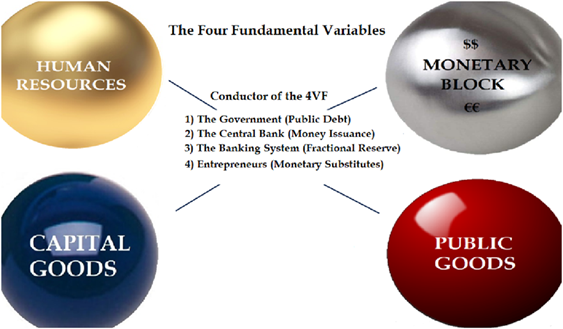
The same applies to privately produced goods: if the population increases (or its purchasing power), it is absurd not to increase industrial and service production, and vice versa.
The same applies to the money supply. If the money supply does not grow at the same rate, there will be less money for more people and economic activity. Therefore, prices will decrease. This economic phenomenon is called deflation. If the amount of money increases beyond what society needs, the opposite effect occurs: inflation.
The only instrument that can properly coordinate these growth rates is the interest rate.
And now that we know the amount of money the market needs,
How should the new money be distributed?
In order to achieve the five monetary issuance objectives described above according to the Interest Pattern, the new money issued by the Central Bank will be distributed as follows:
- Each month, the Central Bank will issue money equivalent to the total interest generated by the entire industrial and financial system.
- The new money will be distributed among public administrations according to their level of activity for the payment of public investments (ports, roads, hospitals, etc.).
- The money will be transferred to private companies' bank accounts. Banks will then negotiate with companies to grant new loans using this money.
- The new loans and credits will generate interest, causing the issuance of new money the following month and restarting the monetary cycle.
This is a circular monetary process, as demonstrated by the following image:
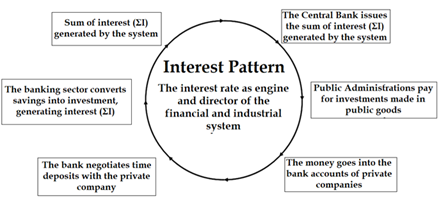
This simple circular mechanism achieves several objectives. Firstly, the industrial and financial markets are coordinated due to the natural interest rate. Secondly, the four fundamental variables (4FVs) should evolve proportionally. This ensures that savings and investment always have the same sign and similar vector ranges.
Thus, the interest rate becomes the director and engine of the financial and industrial system, overthrowing the four current failed directors: the government with public debt, the central bank by issuing money, entrepreneurs through monetary substitutes such as promissory notes and bills of exchange, and private banks using the secondary monetary expansion.
Empirical verification of the Principle.
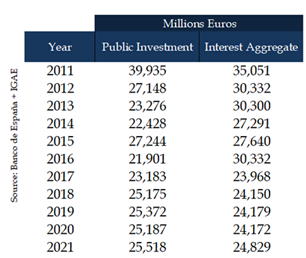
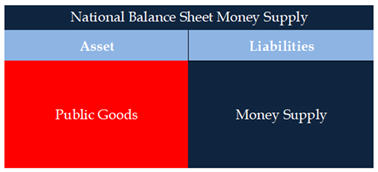
According to this monetary theory, in a healthy economy, the sum of interest payments (ΣI) should equal public investment, as new money will be used to pay for public goods produced by private companies. This means that money will always represent prior and actual labour (a public good). But is this monetary phenomenon observable in reality?
In Spain, for example, this theory is confirmed by observing the evolution of data on public investment and the net aggregate interest generated in the financial system.
Consequences of the Principle
The Progressive Growth of the Money Supply Principle is the monetary anchor that limits the unbridled actions of different monetary actors, ensuring the stability of money's value. With the Interest Pattern, the Central Bank's dominance over the market through the issuance of fiat money can be eliminated. The principle of progressive growth of the money supply is the lost monetary anchor. Thanks to the Interest Pattern, fiscal dominance exercised through public debt will also end, except in extreme situations such as war, pandemics or natural disasters. All public investment will be monetised up to the limit set by the principle. The primary deficit must be zero. Finally, the Interest Pattern will put an end to bank dominance, as using bank deposits beyond the depositor's contractual maturity will be prohibited.
The fiat system is unstable because these core forces act erratically.
Although they may not realise it, readers have just witnessed two pivotal events in economic history. Firstly, the interest rate is staging a formidable coup, overthrowing the failed coordinators of the four fundamental variables and establishing itself as the sole conductor of the monetary orchestra. It is the only reliable tool that provides precise, real-time information on the amount of new money an economic zone needs to maintain the purchasing power of money. In future, the central bank will simply issue money based on the aggregate interest (ΣI) of the preceding period, not intervening directly or indirectly in the formation of the interest rate. Furthermore, the reader has witnessed the unveiling of one of the greatest enigmas of economics in the last five hundred years: how to determine the exact amount of new money that the market needs.
How will the monetary system look like in the 22nd century?
In two centuries' time, the monetary system will function as follows:
- Based on the principle of progressive growth of the money supply, the central bank will have established rules for issuing currency, ensuring that the exact amount of money needed by the market is issued automatically and mathematically. This will be a constitutional norm and any violation will be a criminal offence, severely punished.
- In the future, public administrations will not be able to issue public debt, since the central bank will provide them with the money the market needs, according to pure economic logic and mathematical rationality, month after month. Therefore, it will be difficult to carry out wasteful and megalomaniacal projects. It is worth reminding the reader that, during the housing bubble euphoria at the beginning of the century, Spanish politicians built two airports, one in Ciudad Real and the other in Castellón province, which remained closed for years due to low air traffic in the area and lack of profitability. All public services will be funded by fees. Where it is not possible to apply a fee to a public service, such as the expenditure of State security forces, the cost will be covered by taxes. However, taxes should be the exception to the system, not the general rule. In extraordinary circumstances, Parliament will authorise the ad hoc issuance of money to address wars, pandemics or natural disasters.
- Banks will lose the privilege of fractional-reserve banking (book-entry money); in other words, they will no longer be allowed to use bank deposits — both customer deposits and those obtained in the interbank market — beyond the contract’s maturity date. This will prevent a frenzied secondary expansion of the money supply. Contrary to some opinions, this measure will still allow banks the power to expand the money supply, but will maintain savings and investment vectors with the same direction and a certain degree of correlation. Furthermore, the prohibition will prevent the accumulation of large negative working capital in deposit-taking institutions and will stem the flow of money creation inherent in any bubble. There is a deep-seated and unfounded myth about the liquidity problems this measure would generate. Banks will be able to continue their monetary expansion, but on a smaller scale and with greater discernment than they currently do. The "privilege" of fractional-reserve banking as this incentivises economic cycles and weakens the balance sheet structure of any banking institution, resulting in negative working capital.
- The issuance of short-term securities, with maturities of less than 12 months, will be prohibited. If a company is unable to obtain loans from the financial system or issue long-term securities to restructure or adjust its balance sheet, it is better to file for insolvency proceedings than to continue deceiving the market and competing unfairly. The ECB must be informed of all long-term securities issuances. This will allow it to have detailed knowledge of capital consumption, that is, the interest generated by non-financial entities. Thus, all payments between industrial and commercial companies will be made in cash. Just as we pay in cash for everyday items such as bread or beer, transactions between industrial or commercial businesses will also be conducted in cash. If a company wishes to sell its products on credit, it will need to set up a finance company operating under criteria similar to those of deposit-taking institutions (banks). This finance company will then extend credit to customers, who will use it to pay the invoices of the group's commercial or industrial companies. Therefore, industrial and commercial activity will be completely separate from financial activity. This measure will achieve the following:
- The prohibition of monetary substitutes, which have historically distorted the circulating monetary system. For the Interest Pattern to function properly, we cannot allow loopholes that could circumvent the entire monetary coordination mechanism. If a private company wishes to issue a large, long-term bond, note or similar instrument, it must request special authorisation from the Central Bank. If the amount is small, the Central Bank only needs to be notified of the printing and issuance terms. Short-term issues (less than one year) will not be permitted. If a company has short-term cash flow problems and is unable to issue long-term bonds to restructure its debt, it is better to file for bankruptcy than to deceive the market.
- This measure will favour trade and increase GDP due to the certainty of transactions. This is because, as capitalism matures and new economic activities emerge, the importance of services in industrial and agricultural activity is constantly increasing. In other words, the added value that people contribute to products year on year is greater. Service companies (SMEs) will be able to reach cruising speed more quickly and robustly by collecting their invoices in cash than with the current model.
- By separating companies' industrial and financial activities, we will ensure that all businesses present greater strength and clarity in their financial statements. Currently, more than 80% of European companies fail within two years due to financial problems. The economy will become more robust.
The Interest Pattern will eliminate two major issues that have plagued society since classical Greece. Thus, we will finally eradicate the virus of economic cycles. There will still be economic fluctuations in the future, but economic depressions will disappear. Finally, we will destroy the largest driver of social inequality and population ageing: the frantic printing of money.
The Interest Pattern will be the tool that economists will use to issue money in a few years' time, because it is a non-manipulable, robust, logical and seamless solution, defined by its simplicity. Let us remember what Leonardo da Vinci said about the simplicity of solutions: 'Simplicity is absolute sophistication.'
A more stable economy with a store of value is possible.
Pedro Gómez
Lawyer & Professor
Master's Degree in Financial Consulting and Insurance
Technical University of Valencia
Last edit: 29 May 2026 16:55 by Pedro Gómez Martin-Romo .
Reply to Pedro Gómez Martin-Romo
Moderators: Miguel Saludes, Abelardo Pérez García, Oílda del Castillo, Ricardo Puerta, Antonio Llaca, Efraín Infante, Pedro S. Campos, Héctor Caraballo
Time to create page: 0.206 seconds