Say what you want about President Trump, his enthusiasm for America and its founding—especially the Declaration of Independence—is refreshing. His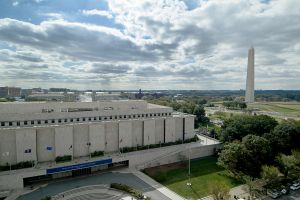 administration has recently been fighting with the Smithsonian Museum of American History, which has evolved into a museum ambivalent about America.
The Domestic Policy Council of the White House has recently published a report critical of the leadership and practices of the Smithsonian. It makes a strong case.
Here are just three of many examples that illustrate the problem:
- In a year when our nation is celebrating the 250th anniversary of the Declaration of Independence, the National Museum of American History has no major exhibit on the founding or on any single founder. Indeed, the one exhibit that purports to commemorate our nation’s 250th anniversary—In Pursuit of Life, Liberty & Happiness—focuses primarily not on historic items from the founding era, but on objects of political activism: a butterfly graduation gown, a drag queen photo, and a 12-foot immigrant farm worker statue of liberty.
- In an exhibit called Upending 1620: Where Do We Begin?, the Museum presented the Christian Pilgrims to America not as “settlers,” but as “colonizers.” Another exhibit stated that “Christian religious fervor … lay behind early European efforts at conquest in the Americas,” and is part of the Museum’s broader framing of Christianity as an instrument of subjugation and cultural erasure. At the same time, the Museum is silent about Christianity’s important influence on the American Founding, the anti-slavery movement leading up to the Civil War, and the civil rights movement of the 1950s and early 1960s.
- The Director of the National Museum of American History has explicitly stated that her intention regarding the 250th anniversary of the Declaration of Independence is to “problematize” it. She sees history, she says, as a “prime tool of social justice” and believes that one of her jobs is to connect “research and scholarship to activism and advocacy.”
Sadly, patriotism today is a divisive issue in America. In a recent Gallup poll, 46 percent of respondents said they are “moderately proud,” “only a little proud,” or “not at all proud” to be American. Among younger Americans between the ages of 18 and 34 the figures were significantly worse.
Fifty years ago, Americans came together as one, despite political differences, to celebrate the 200th anniversary of the Declaration. If we are to revive that common love of our great nation, a good place to start would be to fix what is wrong at the Smithsonian Museum of American History.


Larry P. Arnn , President
Hillsdale College
Pursuing Truth and Defending Liberty Since 1844
larry.p.arnn@hillsdale.edu
Comments powered by CComment