 We are living in times of change in the Americas and the world. In Venezuela, elections are urgently needed to carry out a transition of power, not one manipulated by a criminal group; in Bolivia, the restoration of the essential elements of democracy, which are currently nonexistent, is urgently needed; the end of the Cuban dictatorship, not its modernization, is an ongoing ultimatum; and the Nicaraguan regime can no longer be protected by its bourgeoisie.
The first Summit of the Americas in 1994 initiated the goal of full democracy. This initiative, proposed by President George W. Bush after he lost the election to Bill Clinton, was accepted and implemented in both content and personnel, giving rise to a bipartisan U.S. foreign policy toward Latin America.
To survive the defeat of capitalism’s triumph over communism, the only dictatorship in the Americas, Cuba, created the Sao Paulo Forum, advocating the "multiplication of axes of confrontation," regionalism, indigenism, sexism, generational clash, racism, and more.
With Hugo Chávez’s rise to the presidency of Venezuela in 1999, he immediately offered support to the Cuban dictatorship and became Castro’s capitalist partner, giving rise to "Castro-Chavismo." This facilitated the expansion of the Cuban dictatorship, and under the guise of anti-imperialism, they seized dictatorial control of Venezuela, Nicaragua, Bolivia, and Ecuador, establishing a structure of "narco-states."
The result was the replacement of politics with organized crime, using drug trafficking, corruption, and systematic human rights violations as tools of control and domination—state terrorism as the form of government. The rule of law was replaced by state terrorism, and democratic systems by narco-terrorism.
The populist group became the most successful transnational organized crime organization, controlling governments and international bodies like the OAS under Insulza. With anti-imperialist and pro-narcoterrorism rhetoric, they waged aggression using "hybrid warfare." They became platforms for the penetration of extra-hemispheric dictatorships such as China, Russia, Iran, and others.
The death of Hugo Chávez, already attributed to the Castro dictatorship, gave Cuba absolute control of the group and made Venezuela its satellite state with the imposition of Nicolás Maduro as dictator. Cuba remained the leading dictatorship and the oldest narco-state, while Venezuela, Bolivia, Nicaragua, and Ecuador, under Correa, became its satellite dictatorships, with their governments becoming subservient to dictatorships.
The moment of greatest power for the criminal group of 21st-century socialism was the 2015 Summit of the Americas in Panama, where President Barack Obama recognized Raúl Castro’s leadership of Latin America. Months later, relations between the United States and Cuba resumed, with benefits already documented in history.
This changed in 2025 with Donald Trump, who implemented a new national security strategy that altered both US domestic and foreign policy, identifying organized crime and narco-terrorism in positions of political power and/or under its protection as aggressors. Operation Southern Spear, the capture of Nicolás Maduro, and Operation Shield of the Americas are concrete actions reflecting this ongoing geopolitical shift.
However, the criminal group of 21st-century socialism has standardized the strategy of the Cuban dictatorship, which has been in power for 67 years: in crisis, "cede ground and gain time," relying on the weakening and change of government in the United States.
The end of the dictatorships/narco-states of 21st-century socialism will only happen under at least three conditions: elimination of the dictatorial legal structure, no impunity, and the outlawing of the instruments, parties, and political organizations of organized crime.
The actions of the United States have weakened the dictatorial system but have not ended it. The restoration of democracy in Venezuela is delayed because the process is in the hands of the very same thugs of the dictatorship, and the way to resolve this is to hold elections as soon as possible so that the transition can be carried out by a legitimate government.
In Bolivia, there is a government of hope, but it is trapped in a system of dictatorship that encompasses everything from the establishment of the plurinational state and control of the judiciary to impunity, the narco-state, and more. There is no change or democracy while this pseudo-institutional dictatorship persists.
The Cuban tyranny defies the United States’ ultimatum, and the criminal group refuses to return freedom to the people, apparently confident in the support of the dictatorships of Russia, China, Iran, North Korea, and the para-dictatorial governments of Brazil, Mexico, and Colombia.
The Nicaraguan dictatorship waits and relies confidently on the power of its bourgeoisie with influence and lobbying in the first world.
It is time to persist until we end dictatorships, whose end is the only verifiable sign of real change.
--------------------------
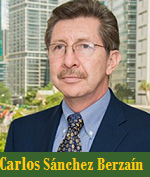
Carlos Sánchez Berzaín is a lawyer and Political Scientist. Director of the Interamerican Institute for Democracy
https://www.carlossanchezberzain.com/
Twitter: @csanchezberzain
Facebook: https://www.facebook.com/sanchezberzaincarlos