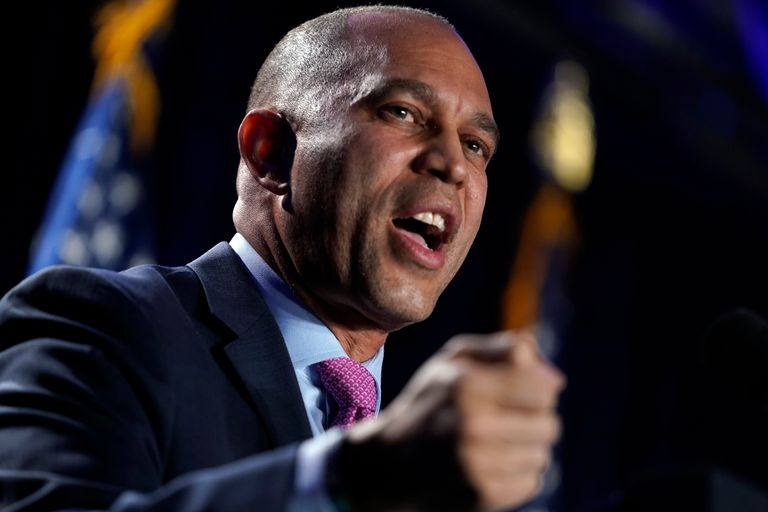
 Following a major 6-3 Supreme Court decision in Louisiana v. Callais on April 29, 2026, House Minority Leader Hakeem Jeffries, who served as a House Impeachment Manager during the first trial of Donald Trump in 2020, heavily criticized the Court, labeling it an "illegitimate" and "corrupt conservative majority." Furthermore, he joined other Democrats in calling for a structural overhaul of the Supreme Court, stating that "everything is on the table," including the potential expansion of the Court or the imposition of term limits, because it "is an extension of Donald Trump's influence". For the American people in the upcoming mid-term elections, this situation presents a choice: to have the next potential Speaker of the United States declaring the Supreme Court illegitimate because he disagrees with its interpretation of the law. Jeffries has thus suggested, among his proposals, that court expansion is a serious option under consideration if Democrats regain control of the House, adding six additional judges in a move that would be seen as a massive partisan shift.
Jeffries failed to acknowledge the reasons behind the majority vote in the Supreme Court's decision in Louisiana v. Callais that took 36 pages to explain that Section 2 of the Voting Rights Act focuses on combating intentional racial discrimination, rather than permitting racial gerrymandering. In this Louisiana case, Democrats attempted to base redistricting on racial boundaries, violating the Civil Rights Act of 1964 prohibiting the application of different standards to white and black voters in federal elections, as well as the Voting Rights Act of 1965, which prohibits racial discrimination in voting by gerrymandering on racial boundaries. The law specifically outlaws map-drawing techniques such as "packing," which involves concentrating voters of a particular race to form a majority that dilute minority voting strength and prevent them from ever electing candidates of their choice.
Just for the record, the Supreme Court did not strike down Section 2, as falsely alleged, but said that neither the law nor the Constitution allows legislators to manipulate district lines to guarantee that candidates of a particular race will be elected.
But the most concerning aspect of this incident is that Jeffries was not addressing this specific case, but rather the Court itself. The man who is poised to become the next Speaker of the House if Democrats regain power in November has joined other radicals in denying the legitimacy of the nation’s highest court, thus promoting chaos that could lead to a future where a consolidated "majority" dictatorship emerges. Six additional Supreme Court judges elected by a Democratic Party legislative majority has no precedent and it would be a radical action leading to a dictatorship of majorities, in contrast of the historical fact that there was no such movement during the decades when a liberal majority set aside an array of long-standing cases. It is just when a stable conservative majority emerged that Jeffries and other radical and socialist Democrats declared the Court illegitimate or dangerous.
This revolutionary tendency is quite evident since Democratic strategist James Carville stated matter-of-factly: “They’re going to recommend that the number of Supreme Court justices go from nine to 15. That’s going to happen, people.” And he added recently, “Don’t run on it. Don’t talk about it. Just do it.”
It's encouraging to know that some Democratic representatives and senators are beginning to recognize the dire anti-democratic implications of the biased campaign targeting the Supreme Court. In private conversations, they have criticized House Minority Leader Hakeem Jeffries (D-NY) labeling the U.S. Supreme Court as "illegitimate," because such rhetoric undermines the US judicial system and democracy itself. Are they intimidated from expressing their worries in public?
Let us hope that voters' common sense will determine that Representative Hakeem Jeffries will never again be elected to the US Congress.
Comments powered by CComment